
Last Updated: October 29, 2026
Quick Summary
Self storage security combines controlled PIN gate access, CCTV surveillance, perimeter fencing, lighting and on-site management, because no single layer protects your belongings alone. Each measure covers a gap the others leave open, so judge a facility on how its layers work together rather than on one feature.
- Cameras deter casual thieves and record evidence, but cannot see inside a closed unit.
- Each renter should receive a unique access code rather than a shared gate PIN.
- Access logs record the code used, date, time, gate and whether entry was granted or denied.
- SSAA guidelines are voluntary recommended practices, not a certification or insurance guarantee.
- Use a disc padlock, never share your PIN and visit your unit occasionally.
Table of Contents
- Why Self Storage Security Matters More Than Renters Realise
- How CCTV and Video Surveillance Actually Protect Your Unit
- PIN Access, Entry Codes and Controlled Gate Access
- SSAA Self Storage Guidelines and What Compliance Means in Practice
- How to Secure a Storage Unit: Locks, Habits and Common Mistakes
- Choosing Self Storage Unit Locks That Hold Up
- Your Self Storage Security Checklist Before You Sign
- Book a Unit and Inspect the Security Yourself
- Frequently Asked Questions
Why Self Storage Security Matters More Than Renters Realise
Most people think about security for about ten seconds before signing a lease. Then they load a trailer full of furniture, tools or stock and drive away.
That order is backwards. Your belongings sit behind someone else’s gate for weeks or months.
Here is what most guides miss. A storage facility is not a bank vault.
Below, we break down exactly what each layer does, where it fails, and what you should check before you sign.
For the bigger picture on how facility design protects your goods, read our guide to how storage facility security protects your belongings.
How CCTV and Video Surveillance Actually Protect Your Unit
CCTV and video surveillance deter casual thieves, record evidence when something goes missing, and let managers watch entries and shared areas in real time. Cameras do not physically stop anyone, but they can deter people considering a break-in.
A common mistake is assuming cameras cover every square metre of a facility. They rarely do. Good operators place cameras at gates, driveways, loading bays and shared corridors.
What Camera Coverage Can and Cannot Do
Camera coverage catches movement at entry points, records number plates, and gives police a timeline after an incident.
So judge a facility on placement, not on camera count. Ask where the cameras point and whether footage is monitored or only recorded.
If you want to know how your footage is stored and handled under Australian privacy rules, our guide to CCTV storage footage and data protection covers it.
PIN Access, Entry Codes and Controlled Gate Access
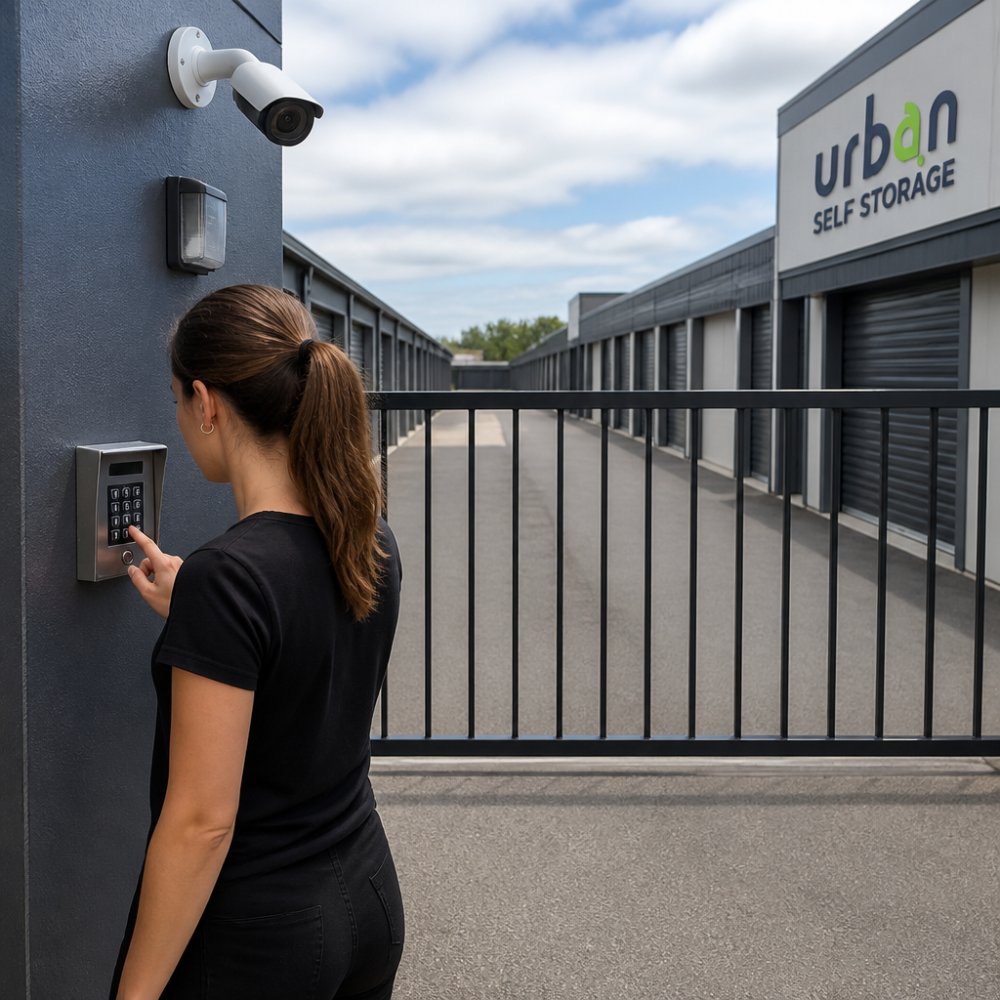
Controlled access means you cannot walk or drive into the facility without identifying yourself. Most sites use electronic access control: a keypad at the gate, a unique access code for each renter, and a record of every entry.
How a Unique Access Code Is Issued
When you sign a lease, the facility assigns you a code rather than giving you a shared one. Access systems of this kind can link a code to a lease record and unit number, which is what allows each entry to be traced back to a specific renter and unit.
Some facilities let you choose your own PIN; others generate one. Either way, the code should be unique to you.
What Happens When a Code Is Compromised
This is the part most guides skip. If you suspect someone else knows your PIN, contact the facility promptly and ask whether the code can be revoked and reissued.
Ask before you sign:
- Can my code be changed on request, and is there any delay?
- How quickly is the old code disabled?
- Would I be notified if my code were used at an unusual time?
What Access Logs Actually Record
Access logs are the audit trail behind the keypad. Access systems commonly record:
- The code used and the renter it belongs to
- The date and time of each entry and exit
- The gate or door used
- Whether the entry was granted or denied
A denied entry can be as informative as a successful one. Ask the facility whether it reviews denied entries.
Sharing Risks and Common Mistakes
- Sharing your PIN with family or friends, convenient, but it breaks the audit trail and makes it harder to establish who entered when.
- Giving your code to a removalist, if you must, ask the facility whether they can issue a temporary code instead, so yours is not exposed.
- Writing the code on the lease or your phone case, obvious, but common.
- Assuming the code is the only layer, the gate code gets you in; the unit lock is what protects your goods once you are inside.
If you are storing with a business and staff need access, ask whether the facility supports multiple codes per lease with separate audit trails. That keeps accountability clear if something goes missing.
Why This Matters for You
Access logs can help establish who entered a facility and when. Ask any facility whether it keeps logs, how long it holds them, and whether it can produce them on request.
SSAA Self Storage Guidelines and What Compliance Means in Practice
The Self Storage Association of Australasia (SSAA) is an industry body for the self storage sector, and it publishes guidelines covering security, operations and customer care. The keyword asks about SSAA guidelines specifically, so it is worth being precise about what they are and are not.
What the Guidelines Actually Cover
SSAA guidance is built around recommended practices rather than prescriptive rules. In practice, the areas most relevant to a renter are:
- Access control, individual entry codes, logging of entries and exits, and procedures for cancelling access when a lease ends
- Surveillance, camera coverage of entry points, driveways and shared areas, plus retention and handling of footage
- Perimeter and physical security, fencing, lighting, gate hardware and unit-level lock points
- Operational procedures, staff training, incident response, key and code management, and record keeping
Compliance Is Voluntary, and That Matters
SSAA membership and adherence to its guidelines are voluntary. Following voluntary guidelines is one input in assessing a facility, but it is not a guarantee. The guidelines describe recommended practice; they do not certify that any individual facility’s systems work as intended on a given day.
Book Online in 3 Minutes & Get 50% Off Instantly →
Treat compliance as one input in your assessment, not the whole assessment. A facility can follow guidelines and still have gaps in day-to-day practice.
Do not assume that a facility’s SSAA affiliation means your belongings are insured or that the facility accepts liability for loss. Insurance and liability are separate matters governed by your lease and your own policy.
How to Verify a Facility’s Claims
Because compliance is self-reported, the useful question is not “are you SSAA compliant?” but “show me how.” Ask for specifics:
- Which access control system is used, and can you see an example of an access log?
- Where are the cameras, and how long is footage retained?
- What is the written procedure when a break-in is suspected?
- Are staff trained in incident response, and how often?
A facility that can answer these questions specifically is demonstrating the substance behind the claim. A vague answer is itself information.
What the Guidelines Do Not Do
SSAA guidelines do not replace your own precautions. They do not cover what you store, how you lock your unit, or whether you share your PIN. They also do not override Australian privacy law, which governs how camera footage and personal information are collected, used and disclosed. For how footage handling works in practice, see our guide to CCTV storage footage and data protection.
How to Secure a Storage Unit: Locks, Habits and Common Mistakes
Securing your unit is a partnership between you and the facility. Your lock, code and what you tell others are within your control.
The biggest mistake renters make is treating the padlock as an afterthought. A cheap lock on a well-guarded unit is still a weak point.
- Use a disc padlock, not a standard shackle padlock
- Never share your PIN, not even with family
- Keep valuable small items at the back of the unit
- Visit occasionally so the unit does not sit unchecked
For a full step-by-step walkthrough, see how to secure a self storage unit.
Choosing Self Storage Unit Locks That Hold Up
Self storage unit locks should be solid, weather-resistant and hard to cut.
Common lock types include:
| Lock type | Best for | Watch out for |
|---|---|---|
| Disc padlock | Most units, best all-round | Needs the right shackle size |
| Closed-shackle padlock | Exposed outdoor units | Can jam in coastal weather |
| Combination padlock | Renters who lose keys | Code can be shared or guessed |
| Cylinder lock | Facilities that supply them | You rely on the facility’s key |
A disc padlock resists bolt cutters better than a standard padlock because the shackle is shielded. That is why it is the common pick for storage.
One honest limitation: no padlock stops an angle grinder. The lock buys time and makes noise. The gate, cameras and staff do the rest.
Your Self Storage Security Checklist Before You Sign
Run this checklist when you inspect a facility before you sign.
- Gate uses individual PIN codes, not a shared code
- Cameras cover the gate, driveway and shared corridors
- Perimeter fencing is intact with no climbable gaps
- Lighting works, including motion-sensor lighting at night
If you want a structured way to compare two facilities, our guide to choosing a secure self storage facility walks through it.
Book a Unit and Inspect the Security Yourself
Reading about security only gets you so far. The real test is standing at the gate with your own eyes on the cameras, the fence and the lock point.
Urban Self Storage operates two Bunbury area locations, in East Bunbury and Picton. Our facilities offer 24/7 CCTV surveillance, flexible short and long-term storage options, and a simple move-in process. You can book online.
We would rather you inspected the security before you commit. If you are storing a van, trailer or watercraft, our Caravan Storage in Bunbury and Bunbury’s Boat Storage Facility are worth a look, and bringing your measurements means you book the right size the first time.
Urban Self Storage has a social proof figure of 5k+ happy customers. One customer described the units as “clean, secure, and easy to access.”
Get started with Urban Self Storage. Book a unit and inspect the security yourself.
Frequently Asked Questions
How can I make my storage unit more secure?
Start with a disc-style padlock, which resists cutting better than a standard shackle lock. Keep your PIN access code private and never share it, even with friends helping you move. Store valuables out of sight and away from the door, keep an inventory with photos, and check that your contents insurance covers goods held in storage. Ask the facility how access logs and camera coverage work, and report anything that looks out of place on arrival.
Does CCTV make a storage facility secure on its own?
No. CCTV is one layer, not a complete solution. Cameras deter some theft and provide surveillance footage after an incident, but they cannot cover every blind spot inside a unit. Real self storage security combines camera coverage with controlled gate access, PIN access logs, perimeter fencing, security lighting and on-site management. When inspecting a facility, ask where cameras are placed, whether footage is monitored, and how long it is retained.
Do I need to bring my own lock for self storage?
Check with the facility whether you need to supply your own padlock or can buy one on site. A disc padlock is the usual recommendation because the enclosed shackle is harder to cut than a standard lock. Check whether the facility specifies a lock type or size before you arrive, and keep the only spare key somewhere secure rather than inside the unit. Ask staff about self storage unit locks if you are unsure what fits.
What should I ask a storage provider about its security procedures?
Ask how PIN access works and whether each renter gets a unique access code, whether access logs are kept, where cameras are positioned and whether footage is monitored, and what happens if an incident occurs. Request a walk-through of the facility so you can see the perimeter fencing, lighting and gate. Working through a self storage security checklist before signing gives you a clear picture of how well protected your belongings will be.
Security is not a feature you tick off on a brochure. It is a set of systems you can check, question and see for yourself. Ask the hard questions at the gate. A facility that answers them clearly is the one worth your lease.
