
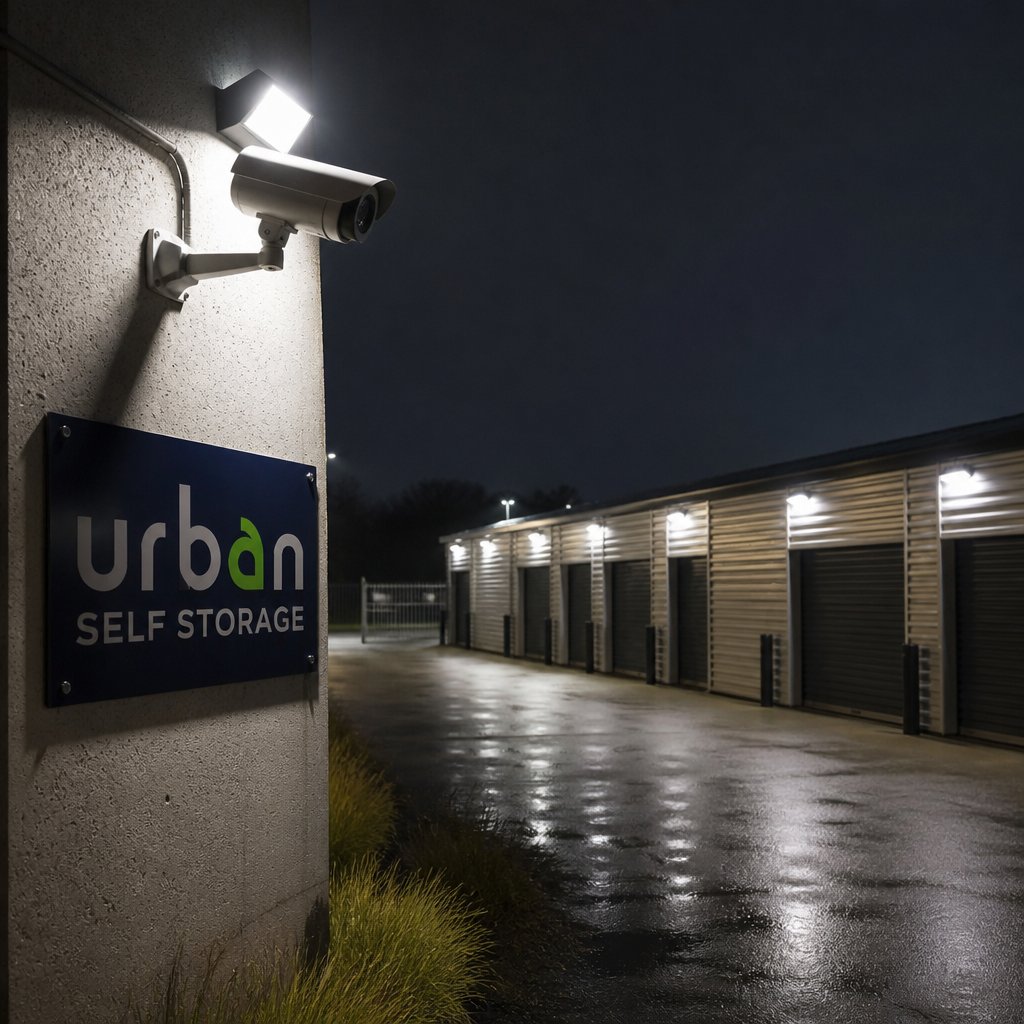
Last Updated: October 30, 2026
Quick Summary
Self storage facilities need security lighting, but no single national rule sets a brightness level in Australia. Lighting duties come from work health and safety law, building and electrical rules, and local council requirements, so check with a licensed electrician and your council before changing fixtures.
- Light PIN pads, gates and the ground around them so faces are identifiable on camera.
- Space poles so pools of light overlap, because gaps between pools are where intruders work.
- Use steady light in busy corridors and motion sensors as a backup, not the main control.
- Walk the site at night and log every fault per zone with the test date and result.
- Simulate an outage to confirm which zones stay lit, and document the response.
Table of Contents
- Why Security Lighting Decides How Safe a Storage Facility Feels
- A Zone-by-Zone Guide to Self Storage Security Lighting Requirements
- CCTV and Lighting for Self-Storage Facilities: Why They Only Work Together
- Motion Sensor Lighting for Commercial Premises: Where It Helps and Where It Fails
- Your Self-Storage Facility Security Checklist for Lighting
- Self-Storage Facility Lighting Maintenance and Failure Response
- Book a Walkthrough and See the Lighting for Yourself
- Frequently Asked Questions
Why Security Lighting Decides How Safe a Storage Facility Feels
Walk into a storage facility after dark and your body reacts before your brain does. Bright, even light says “someone is watching this place.” A shadowy corridor says the opposite. For a broader checklist of what a high-security facility looks like, see our signs of a high security storage facility.
At Urban Self Storage, we light our East Bunbury and Picton sites with this in mind. Good light does two jobs at once. It helps people find their unit and move safely, and it removes the cover that thieves rely on.
What Australian Standards Actually Require
There is no single national rule that sets a brightness level for storage facilities. Lighting duties come from a mix of sources:
- Work health and safety law, which requires safe premises for staff and visitors
- Building and electrical rules, covering how fixtures are installed and wired
- Local council requirements, which vary by area
The practical takeaway: check with a licensed electrician and your local council before you change or add fixtures. Don’t guess at numbers.
The Difference Between Compliance and Deterrence
Meeting the minimum is not the same as being secure. A site can pass every inspection and still have blind spots behind the bins. Security lighting designed for deterrence goes further:
- It lights the paths people actually walk
- It covers the spots a person could hide
- It stays on when it matters most
Compliance keeps you legal. Deterrence keeps your customers’ belongings safe. Aim for both.
A Zone-by-Zone Guide to Self Storage Security Lighting Requirements
Treat lighting as a map of your site, not one big switch. Each zone has a different job, and each needs its own check. The guidance below separates what is typically enforceable, building, electrical and work health and safety duties, from what is a security recommendation.
Entrances, Exits and PIN Access Points
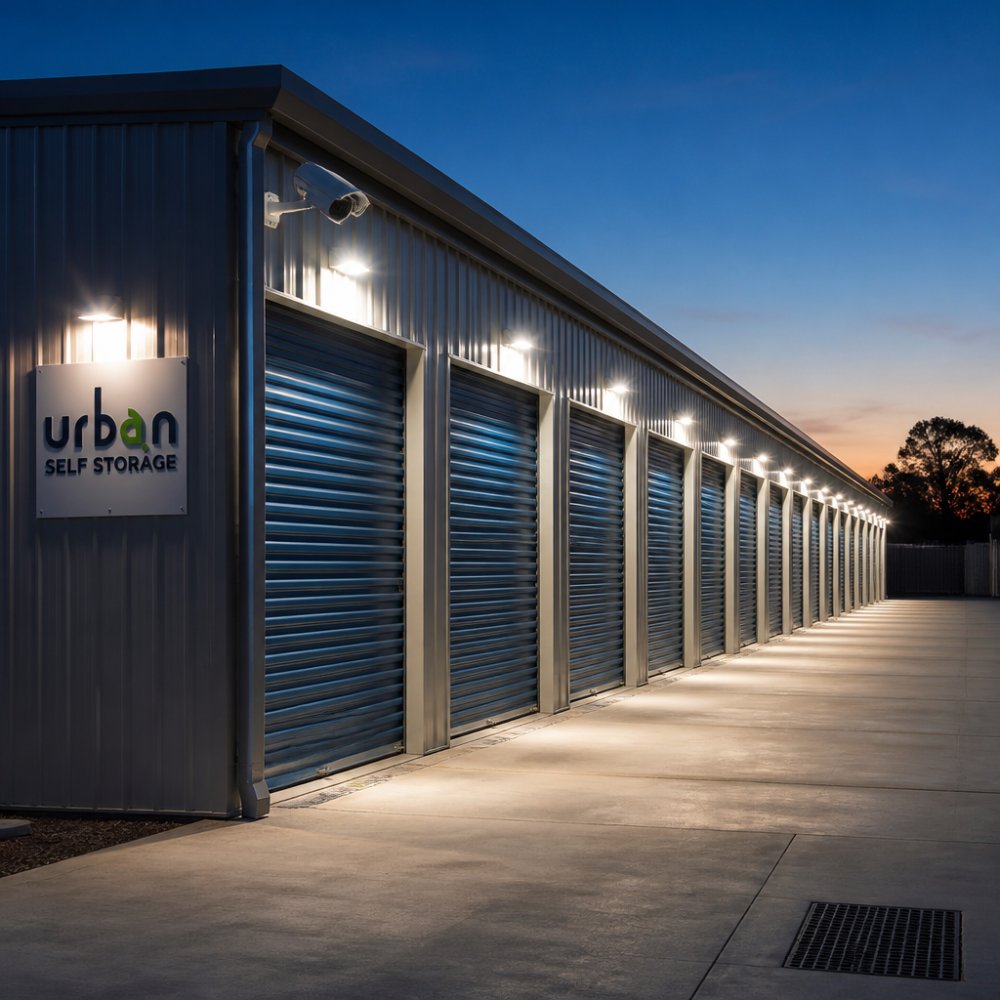
These are the highest-risk spots. Anyone entering or leaving passes through them, and a dark keypad is a gift to a thief. Light the PIN pad, the gate, and the ground around it clearly. Aim for enough illumination that a person’s face is identifiable on camera at the keypad, with uniformity across the approach so there is no shadow falling on the keypad itself. Mount fixtures so light falls onto the pad and the user’s hands, not behind them. A customer fumbling in the dark at 9pm is a customer who won’t come back.
Measure at night with a lux meter held at the keypad and at eye height on the approach. Record the readings so you can prove the zone was lit to a consistent standard.
Driveways, Parking Bays and Perimeter Fencing
Cars and boats need room to move, and drivers need to see the edges. Light the full driveway, not just the middle. Sweep light along the fence line so no one can work in shadow. Motion sensors help here, but they must cover the whole run, not just a few spots. For perimeter fencing, mount fixtures at a height that throws light along the fence rather than over it, this reduces glare and light trespass while keeping the fence line visible. Space poles so the pools of light overlap; gaps between pools are where intruders work.
Corridors, Unit Doors and Dark Corners
This is where most facilities fall short. Corridors need even light down their full length. Every unit door should be visible from the corridor. Walk your site at night and look for dark corners, behind stairwells, near bins, at the ends of rows. If you can’t see into a corner, neither can a camera. Pay attention to fixture spacing: if lights are too far apart, the corridor becomes a series of bright and dark patches, and the dark patches are the problem.
Do not rely on a single bright fixture to cover a long corridor. Uneven light creates blind spots that are invisible in daylight but obvious to anyone who visits after dark.
Measuring and Documenting Each Zone
A zone-by-zone guide is only useful if you can prove each zone meets its target. Use a lux meter and take readings at floor level and at camera height in each zone. Note the reading, the time, and the fixture condition. Where a zone falls short, record the corrective action, a new fixture, a re-aim, a replacement lamp, and the date it was completed. This record is what turns a walkaround into an audit, and it is what separates a site that looks lit from one that is demonstrably lit to a consistent standard.
CCTV and Lighting for Self-Storage Facilities: Why They Only Work Together
A security camera in the dark records nothing useful. CCTV and lighting for self-storage facilities are a package deal: the camera needs light to see faces, plates, and movement. Poor light turns footage into a blurry grey mess that helps no one.
Adding cameras without fixing the light is money wasted. To see how lighting and surveillance fit into a complete setup, read our guide to storage facility security systems. The camera is only as good as the scene it records.
Book Online in 3 Minutes & Get 50% Off Instantly →
Motion Sensor Lighting for Commercial Premises: Where It Helps and Where It Fails
Motion sensor lighting for commercial premises saves power and startles intruders. It works well on perimeter paths, car parks, and low-traffic areas. When a light snaps on, most people with bad intentions leave.
But sensors fail in high-traffic zones. Constant triggering wears them out and annoys customers. In busy corridors, use steady light with sensors as a backup. Match the control to the zone:
| Zone | Best control | Why |
|---|---|---|
| Perimeter and fence line | Motion sensor | Saves power, startles intruders |
| Car park and driveway | Motion sensor plus timer | Covers arrivals after dark |
| Corridors and unit rows | Steady on, photocell | Even light, no flicker |
| PIN pads and entries | Steady on | Safety and clear visibility |
Your Self-Storage Facility Security Checklist for Lighting
Use this self-storage facility security checklist to audit your site after dark. Walk it at night, not in daylight.
- Every entry, exit and PIN pad is clearly lit
- Driveways and parking bays are fully visible
- The fence line has no dark gaps
- Corridors are evenly lit end to end
- Every unit door is visible from the corridor
- No dark corners near bins, stairs or row ends
- Cameras cover lit areas, not shadows
- Motion sensors cover the full perimeter run
- Emergency and exit lights work
- Backup power is tested
Self-Storage Facility Lighting Maintenance and Failure Response
Self-storage facility lighting maintenance is the part everyone forgets. A bulb dies quietly. A sensor stops triggering. Nobody notices until something goes wrong. The gap most guides leave is the operational plan: not just what to check, but how to test it, what to do when a zone fails, and how to prove the response happened.
Build a simple routine:
- Check weekly. A quick night walk to spot dead fixtures. Note the zone and the fixture type.
- Test monthly. Trigger every motion sensor and check backup power. Record the result for each zone.
- Log every fault. Note what failed and when, so patterns show up.
- Fix fast. A dark zone is a security gap, not a cosmetic issue. For practical steps on improving an existing site, see our guide to upgrading existing storage unit security.
Controls, Backup Power and Failure Response
Lighting controls need their own testing schedule. Photocells and timers should be checked to confirm they switch on at the right light level and do not leave zones dark during an overcast day. Motion sensors should be triggered manually and their coverage confirmed, not just assumed. Emergency and exit lighting should be tested in line with the applicable electrical and building requirements for your jurisdiction, confirm the required interval with a licensed electrician, as it varies.
Backup power deserves a specific test: simulate an outage and confirm which zones remain lit. If a zone goes dark during an outage, that is a security gap, and the response should be documented. A simple failure response plan covers:
- Who checks the site after an outage
- Which zones are prioritised for temporary lighting
- How faults are logged and closed out
- When a failed fixture is replaced versus repaired
A lighting maintenance plan is only as good as its records. Keep a log per zone showing the last test date, the result, and the corrective action. That log is what lets you spot a failing circuit before it becomes a dark corridor.
Book a Walkthrough and See the Lighting for Yourself
You don’t have to take our word for it. Come and see a lit site after dark.
At Urban Self Storage, our facilities run on advanced 24/7 CCTV surveillance and modern, clean, secure layouts. We offer flexible short and long-term options, from furniture storage in Bunbury and business storage in Bunbury to caravan storage in Bunbury and boat storage. Move-in is simple and hassle-free. Visit our Bunbury self storage page to check services and arrange a visit.
Frequently Asked Questions
Are there specific lighting requirements for self-storage facilities in Australia?
There is no single national rule that sets light levels for storage facilities. Instead, obligations come from several places: the National Construction Code and its referenced Australian Standards for artificial lighting and emergency escape lighting, state and local planning or development conditions, and your insurer’s risk requirements. Some councils impose extra conditions on new or expanded facilities. Because these vary by site, ask your local council and insurer what applies to your building before you specify fixtures.
How bright should security lighting be around storage units?
Brightness should be set by task, not by guesswork. Walking routes, PIN entry areas and unit doors need enough even light for a person to read a keypad, unlock a padlock and see the ground around them without shadows. Car parks and perimeter areas need coverage across the whole surface rather than a single bright hotspot. A lighting designer or electrician can measure levels in lux against the relevant Australian Standard for your building class, which is more reliable than judging by eye.
Are motion sensor lights suitable for self-storage facilities?
Motion sensor lighting for commercial premises works well in low-traffic zones such as perimeter walkways, bin areas and rarely used access doors, where it saves energy and draws attention to movement. It is a poor fit for main corridors, PIN entry points and camera fields, because a dark camera view is useless and customers should never walk into an unlit space. The practical approach is a mix: constant low-level lighting on main routes, with motion sensors boosting brightness in secondary areas.
How often should security lighting be inspected and maintained?
A monthly visual check and a documented annual electrical inspection is a workable baseline for most facilities. Monthly checks should confirm every fixture works, no lens is cracked or dirty, no pole is leaning and no vegetation blocks a light. Annual checks should cover test-and-tag style electrical safety, emergency and exit lighting discharge tests as required, photocell and sensor operation, and a night walkthrough to spot dark patches. Log every fault and repair date so you can show an audit trail to insurers.
Lighting is one of those things that’s easy to overlook until it’s too late. If you want storage where the light, the cameras and the access all work together, get started with Urban Self Storage and store with confidence. Book online now.
