
Quick Summary
A secure storage facility should have gated PIN access with individual codes, 24/7 CCTV with recorded footage retention, individually alarmed units, well-lit corridors and outdoor areas, fire detection and sprinklers, on-site or remote monitoring, cut-resistant disc locks, and clear insurance terms. Verify these features in person during a site visit rather than relying on marketing claims.
- Check perimeter fencing, boom gates and whether PIN codes are individual and logged for each entry
- Confirm CCTV covers gate, corridors, unit doors and perimeter with at least 30 days footage retention
- Ask whether each unit has its own door alarm and who monitors alerts after hours
- Review the facility contract’s liability clauses to understand what your goods insurance must cover
- Walk the facility to inspect lighting, fire safety equipment, drainage and signs of pest damage or water intrusion
Table of Contents
- What Makes a Secure Storage Facility Worth Your Trust?
- How to Inspect a Secure Storage Unit Facility On Site
- Understanding Gated Access and PIN Entry Systems
- CCTV Surveillance: What Proper Coverage Looks Like
- Choosing the Best Lock for a Storage Unit
- Storage Unit Insurance and What It Actually Covers
- Fire and Flood Protection: Critical Safety Standards
- Red Flags That Signal a Risky Storage Facility
- Getting Started With a Secure Storage Facility
- Frequently Asked Questions
What Makes a Secure Storage Facility Worth Your Trust?
Last Updated: October 24, 2026
What Makes a Secure Storage Facility Worth Your Trust?
A secure storage facility protects your belongings with layers of defence: gated access, CCTV coverage, individual alarms, good lighting and fire protection. But not all facilities are equal, the real difference comes down to what you verify on site, not what a website promises.
At Urban Self Storage, we know trust is earned through transparency, you need to see the security yourself before handing over your keys.
A secure storage facility should have:
- Gated access with PIN or keypad entry
- 24/7 CCTV with recorded footage retention
- Individual unit alarms (not just perimeter alarms)
The questions you ask during a site visit matter more than any marketing claim.
How to Inspect a Secure Storage Unit Facility On Site
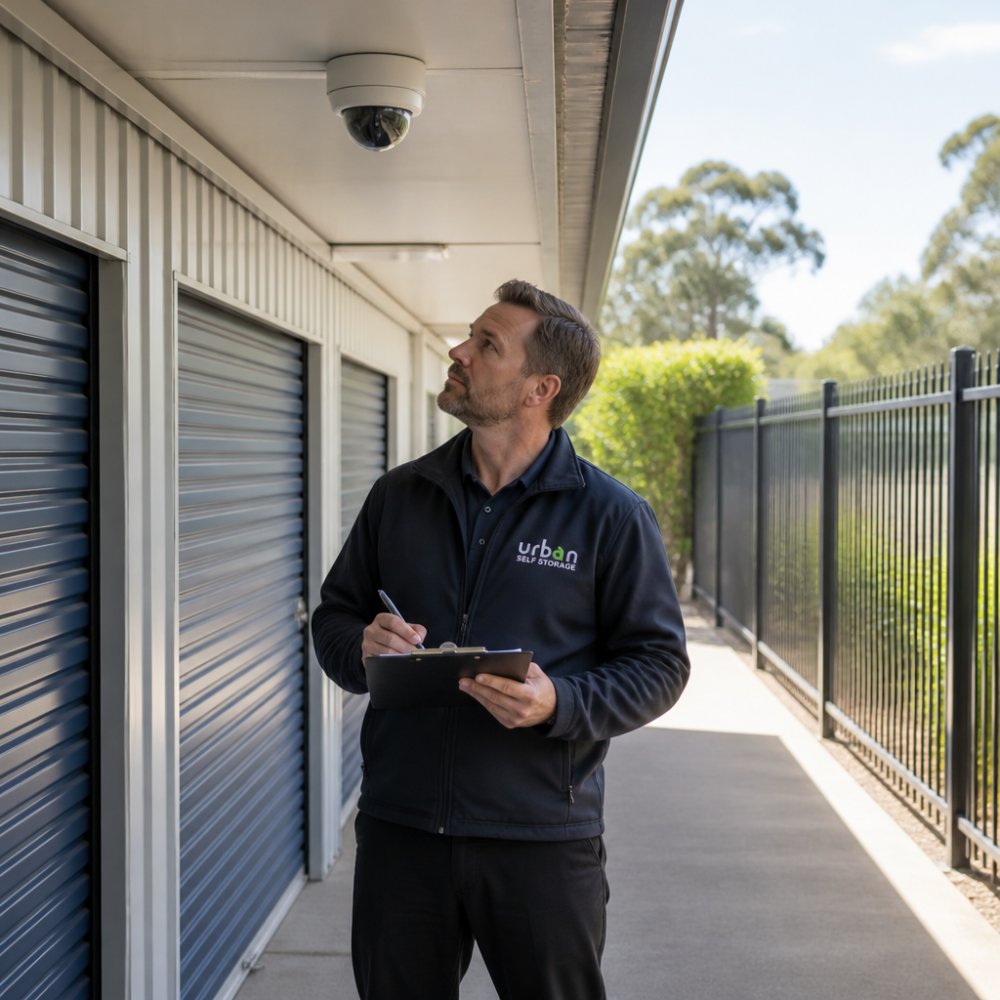
A site visit is the only way to separate a genuinely secure storage facility from one that simply advertises security. Marketing pages list cameras and gates; a walk-through reveals whether those cameras record, whether the gate closes behind you, and whether the lighting reaches the back corner.
The Printable Site-Visit Checklist
Print or save this facility inspection checklist and work through it methodically. Use our ready-made checklist to take on-site when inspecting a facility.
- Perimeter fencing and boom gates, Walk the full perimeter. Is the fence continuous and free of gaps at ground level? Does the boom gate close automatically behind each vehicle, or can it be tailgated?
- Gated access and PIN or keypad entry, Ask whether each tenant receives an individual PIN code and whether the system logs every entry and exit. Shared codes should not exist.
- CCTV coverage and footage retention, Note where cameras point: gate, office, corridors, unit doors, perimeter. Ask how long footage is retained (30 days is a common minimum; 60+ days is stronger) and request a sample.
- Individually alarmed units, Ask whether each unit door has its own alarm or only the perimeter is alarmed. Door alarms per unit are materially stronger. Ask what triggers the alarm and who responds.
- Lighting, Walk corridors and outdoor areas. Are there dark corners? Do lights operate 24/7 or only during office hours? A well-lit facility deters opportunistic theft and makes CCTV footage usable.
- On-site manager or remote monitoring, Is an on-site manager present during business hours? Is there after-hours remote monitoring? Ask who monitors alerts and the expected response time.
- Fire detection and sprinklers, Look for smoke detectors, sprinkler heads and extinguishers. Ask whether the system is regularly tested.
- Flood-prone or low-lying sites, Ask whether the site has flooded previously. Check drainage, floor level and whether ground-level units are raised. Low-lying sites carry higher water risk regardless of security.
- Pest control and maintenance, Inspect floors, walls and ceilings for droppings, water stains or mould. Ask how often pest control is scheduled.
- Indoor vs drive-up units and climate control, Confirm whether your unit is indoor or drive-up and whether climate control is included. It matters for timber, electronics, artwork and documents.
- Lock standard (disc lock vs padlock), Ask what lock the facility recommends or requires. Cut-resistant disc locks are harder to cut and pick than standard padlocks. Confirm whether you supply your own.
- Goods insurance and liability clauses, Request the contract and read the liability clauses before signing. Ask what the facility’s insurance covers (building and facility liability, not your goods) and what tenant insurance you need.
- Items not allowed, Ask for the list of prohibited items (typically flammable liquids, hazardous chemicals, perishables, living plants and animals). Confirm your intended contents comply.
- Access logs, Ask whether the facility can produce a record of who accessed the gate on a given date. If it can’t, it isn’t tracking access meaningfully.
Take photos during your visit, of the gate, camera positions, lighting and unit condition. They help if a dispute arises later and let you compare facilities fairly.
Security Feature Comparison: Basic, Mid-Level and High-Security
The table below compares what you can expect at three indicative security tiers. Cost differences are illustrative only and vary by location, unit size and provider, always request a written quote.
| Feature | Basic | Mid-level | High-security |
|---|---|---|---|
| Perimeter fencing | Chain-wire, some gaps possible | Solid fence with controlled gate | Full perimeter fence with boom gate and anti-climb design |
| Entry control | Shared keypad code | Individual PIN codes, logged | Individual PIN codes with time-stamped access logs and audit trail |
| CCTV coverage | Cameras at gate only, footage retention unclear | Cameras at gate and corridors, 30-day retention | 24/7 CCTV across gate, corridors and perimeter, 60+ day retention, remote monitoring |
| Unit alarms | Perimeter alarm only | Door alarms on some units | Individually alarmed units with monitored response |
| Lighting | Business-hours lighting | 24/7 corridor lighting | 24/7 lighting across all areas including perimeter |
| Fire safety | Extinguishers only | Smoke detection and extinguishers | Fire detection and sprinklers throughout |
| On-site presence | Remote only | On-site manager during business hours | On-site manager plus after-hours remote monitoring |
| Lock standard | Padlock accepted | Disc lock recommended | Cut-resistant disc lock required |
| Indicative cost difference | Baseline | Moderate premium over basic | Highest premium; reflects monitoring and infrastructure |
Match the tier to what you are storing. Household furniture in a short-term unit may suit mid-level security; business stock, tools, electronics or high-value items justify the high-security tier.
Questions to Ask About Security Operations
Features on a brochure tell you what exists; operations tell you whether it works. Ask who monitors alarms and at what hours, what happens after a break-in, whether incident reports are kept, how footage and access logs are protected, and what happens if a PIN is compromised. A secure storage facility should answer without hesitation, evasiveness is itself a red flag.
Understanding Gated Access and PIN Entry Systems
Gated access with individual PIN codes is one of the strongest deterrents to theft. A secure storage facility should have a boom gate or sliding gate requiring a code, creating an access log of who entered and when. Watch for weak points: tailgating, shared codes, codes not changed when customers leave, and unclear visitor access. A truly secure storage facility changes PINs regularly and can tell you exactly who accessed the property on any given day.
CCTV Surveillance: What Proper Coverage Looks Like
CCTV is only useful if it covers the right areas and the footage is actually retained. Many facilities have cameras that look impressive but don’t record or don’t cover critical zones. Ask how many cameras are on site, where they point, whether footage is recorded 24/7, how long it’s kept (30 days minimum; 60+ days is better), who can access it, and whether there’s remote monitoring.
Choosing the Best Lock for a Storage Unit
The lock on your unit door is your last line of defence, a weak lock defeats good gates, cameras and alarms. Disc cylinder locks (disc locks) are harder to cut with standard tools, more resistant to picking, recommended by most secure storage facilities and can be keyed to match your PIN system, though they cost more than padlocks. Padlocks are cheaper and easier to replace but more vulnerable to bolt cutters and picking, suitable for basic storage only.
Storage Unit Insurance and What It Actually Covers
A secure storage facility’s insurance covers the building and the operator’s liability, it does not cover your belongings inside the unit. Understand what insurance actually protects and what gaps exist in coverage. This is the most common misunderstanding in self storage, so resolve it before you sign anything.
What Does Facility Insurance Actually Cover?
Facility insurance typically covers the structure, common areas and the operator’s public liability. It may respond if the facility’s negligence causes loss, but it will not replace your goods after theft, fire or water damage in the ordinary course. Read the contract’s liability clauses carefully: many limit the operator’s liability to a specified amount and exclude certain causes of loss entirely.
Ask the facility directly:
Book Online in 3 Minutes & Get 50% Off Instantly →
- What does your insurance cover, and what are the liability limits?
- What is excluded under the contract’s liability clauses?
- Am I required to hold my own goods insurance, and must I provide proof?
Do I Need Insurance for a Storage Unit?
In most cases, yes, either through an extension of your home and contents policy or through specialist goods insurance. Don’t assume your existing policy covers goods in storage. Ask your insurer whether your policy extends to goods in a self storage unit, what the coverage limit is, whether jewellery, electronics, antiques, business stock or tools are excluded, whether cover is limited by storage duration or the facility’s security standard, and what documentation you need to support a claim.
Many home and contents policies exclude or sub-limit high-value items in storage. If you are storing business stock, tools of trade or valuables, confirm cover in writing before you move in.
What Tenant Insurance Commonly Excludes
Specialist goods insurance and policy extensions vary, but common exclusions include:
- Cash, negotiable instruments and documents
- Jewellery, watches and precious metals beyond a sub-limit
- Items stored contrary to the facility’s rules (for example, prohibited or hazardous goods)
Documentation to Keep
If you intend to claim, evidence matters. Keep an inventory with descriptions, serial numbers and photographs, retain purchase receipts where possible, and store a copy of your policy schedule and the facility contract. Some insurers require proof the facility met a stated security standard, so keep a record of the features you verified on your site visit.
Reviewing Contract Liability Clauses
Before signing, read the liability section of the storage contract. Look for the cap on the operator’s liability, the list of excluded events, and any clause requiring you to insure your own goods. If a clause is unclear, ask for it in writing. A transparent secure storage facility will explain its liability position plainly rather than burying it in fine print.
Fire and Flood Protection: Critical Safety Standards
A secure storage facility must protect against fire and water damage, the biggest threats to stored items after theft. Fire protection should include sprinkler systems throughout, smoke and heat detectors in every section, accessible extinguishers, fire-rated doors and walls in indoor facilities, and clear evacuation routes. Flood protection means a location away from flood-prone areas, proper drainage, raised floors in ground-level units where applicable, and regular inspection for water intrusion.
Red Flags That Signal a Risky Storage Facility
Stop and walk away if you see any of these warning signs: Recognise warning signs of poor security before committing to a rental.
- No perimeter fence or a fence with large gaps
- Broken or non-functioning CCTV cameras
- Dark corridors or outdoor areas with no lighting
A secure storage facility welcomes questions. If the staff seem evasive or defensive, that’s a red flag. Trust your instincts. There are better options.
Getting Started With a Secure Storage Facility
Choosing the right secure storage facility takes time but saves stress later. Use the checklist above. Visit in person. Ask tough questions. Review contracts and insurance carefully.
Urban Self Storage offers secure, flexible storage across the region with 24/7 CCTV surveillance, gated PIN access, individual unit alarms, and well-maintained facilities. Whether you need Large Storage Units in Bunbury, Business Storage in Bunbury, or Short and Long Term Storage in Bunbury WA, we welcome site visits and provide transparent answers about our security measures, access logs and monitoring systems, and can walk you through insurance options and unit sizes.
Book online now to schedule a facility tour and see our security features firsthand. Our quick move-in process gets you stored and protected in less than 10 minutes.
Frequently Asked Questions
What security features should a storage facility have?
A secure storage facility must combine multiple layers: perimeter fencing and gated access with PIN or keypad entry, 24/7 CCTV with recorded footage retention, individual unit alarms, bright lighting throughout, on-site or remote monitoring, fire detection and sprinkler systems, and clear access logs. No single feature is enough; the best facilities integrate all of these. Ask the facility manager to show you how each system works and verify they’re actively monitored, not just installed.
Is self storage safe for valuables?
Self storage can be safe for valuables if you choose a facility with comprehensive security and obtain appropriate insurance. Look for gated access, CCTV coverage of all areas, individually alarmed units, quality locks (disc locks are more secure than padlocks), and good lighting. However, standard facility insurance does not cover valuables; you must arrange your own goods insurance through a provider that covers storage unit contents. Verify what your policy excludes before storing jewellery, cash, or irreplaceable items.
Do I need insurance for a storage unit?
Yes. A secure storage facility’s liability covers the building structure, not your belongings. Your home or contents insurance typically excludes items in storage, so you need separate goods insurance for stored items. Check what your policy covers and what it excludes, many policies exclude high-value items, cash, and documents unless specifically listed. Review the facility’s contract liability clauses to understand what they are responsible for if theft, fire, or water damage occurs. The cost of insurance is usually modest and worth the protection.
What is the best lock for a storage unit?
A cut-resistant disc lock is the best choice for a storage unit. Disc locks have a hardened steel disc that resists bolt cutters, making them far more secure than standard padlocks. Look for locks rated to withstand cutting tools and verify the facility allows them (most do). Some facilities provide or recommend specific locks; ask about this when you visit. Ensure the lock is weatherproof and the shackle is hardened. A quality disc lock costs more than a basic padlock but is a worthwhile investment for protecting your belongings in a secure storage facility.
Choosing a secure storage facility is about verifying security yourself, not trusting promises. A genuine secure storage facility welcomes inspection, answers every question, and shows you exactly how it protects your belongings. Urban Self Storage provides that transparency, visit our facilities and see the security for yourself.
