
Last Updated: October 23, 2026
Quick Summary
How to pack a storage unit efficiently means stacking boxes vertically along the walls, placing heavy items on the bottom, and leaving a clear aisle or walkway down the centre for access. Label everything clearly and create an inventory as you pack.
- Stack identical-sized boxes vertically to maximise storage space, using the full height of your unit which is typically at least 2.4 metres.
- Place large, heavy boxes of books and tools on the floor, then stack progressively lighter boxes on top to create a stable pyramid.
- Leave a clear aisle at least 0.6 metres wide down the centre of your unit so you can retrieve items from the back without reaching over everything.
- Use breathable furniture covers, never plastic, and elevate furniture on pallets or plastic sheeting to prevent moisture damage during humid Australian summers.
- Label each box on the front and top with box number, contents, location and warnings, and keep a searchable inventory with photos of each stack.
Table of Contents
- How to Pack a Storage Unit Efficiently: The Core Method
- Storage Unit Size Guide: Matching Your Contents to the Right Space
- Step-by-Step Packing Method for Maximum Efficiency
- How to Prevent Mould in Storage: Humidity and Heat Protection
- Storage Unit Packing Checklist: Essential Items and Preparation
- Storage Unit Inventory List: Tracking and Labelling Your Belongings
- What Not to Store in a Storage Unit
- Conclusion
- Frequently Asked Questions
How to Pack a Storage Unit Efficiently: The Core Method
Learning how to pack a storage unit efficiently means stacking boxes vertically along the walls, placing heavy items on the bottom, and leaving a clear aisle or walkway down the centre for access.
The difference between a cramped, chaotic space and one that works comes down to three principles: vertical stacking, weight distribution, and planned access.
Treat your unit as a three-dimensional puzzle where every decision affects what fits next.
Stack vertically to maximise storage space
Stacking boxes vertically is the single most effective way to maximise storage space.
Start with sturdy cardboard boxes or plastic bins on the floor, stacking identical-sized boxes directly on top of each other to create stable towers without gaps or wobbling.
Leave a small gap between stacked boxes and the walls. This lets air circulate, prevents moisture buildup, and makes retrieving boxes from the back easier without toppling everything.
Place heavy items on the bottom
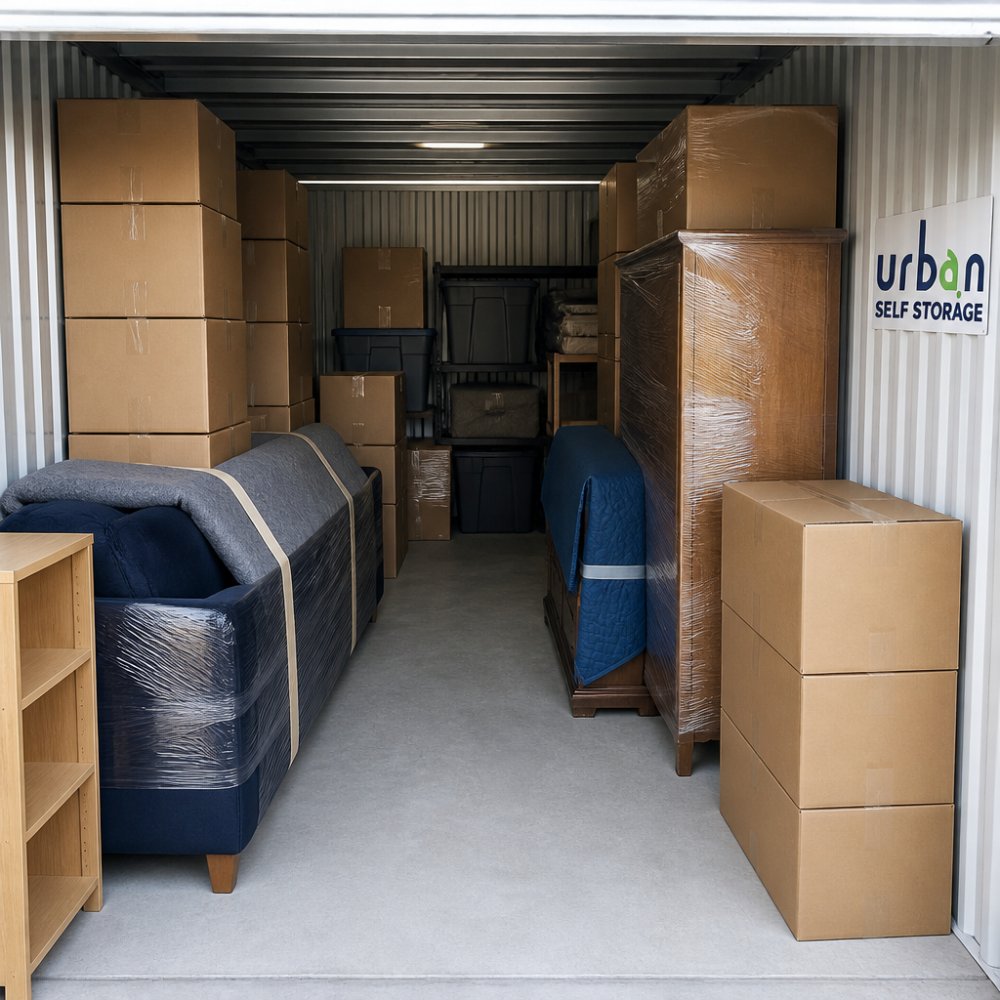
Heavy items always go on the bottom to keep your unit stable and protect lighter belongings. Start with large, heavy boxes of books, tools or dense items on the floor, never stack light items under heavy ones.
Once heavy items are in place, stack progressively lighter boxes on top, creating a stable pyramid. Fragile items and essentials go last, on top where they’re easy to reach.
Leave an aisle or walkway for access
A clear aisle down the centre of your unit is essential, without it, you’ll be reaching over everything to retrieve items from the back. Make it at least 0.6 metres wide.
Stack boxes on both sides of the aisle, with the tallest stacks toward the back and shorter stacks toward the front. This creates a gentle slope that gives you sight lines to items stored deeper inside.
Storage Unit Size Guide: Matching Your Contents to the Right Space
Choosing the right unit size prevents wasted money and ensures your belongings fit properly. A unit that’s too small forces you to squeeze items dangerously; one that’s too large costs more than you need.
Unit sizes and typical contents
1.5m² unit
Holds: Approximately 15-20 small to medium boxes, a few pieces of furniture, or seasonal decorations. Ceiling height: Typically 2.4 metres.
3m² unit
Holds: A single bed, wardrobe, desk, and 30-40 boxes. Or a small lounge suite with additional storage boxes.
6m² unit
Holds: A bedroom set, lounge suite, dining table, desk, and 60-80 boxes.
10m² unit
Holds: Two bedroom sets, lounge suite, dining furniture, kitchen items, and 100+ boxes. Room for a car, caravan, or boat if stored vertically. Ceiling height: Typically 2.4 metres.
Sample packing layouts by unit size
For a 3m² unit:
- Back wall: Stack boxes vertically, heaviest on the bottom.
- Side walls: Lean a mattress against each wall in a breathable mattress bag; lean a wardrobe against one wall.
- Centre aisle: Clear walkway, at least 0.6 metres wide.
For a 6m² unit, create zones:
- Back third: Heavy boxes stacked vertically, furniture on its end or side.
- Middle third: Medium-weight boxes, stacked uniformly.
- Front third: Lighter boxes, frequently accessed items, and your aisle.
For a 10m² unit, think of it as a small room:
- Back half: All heavy furniture and boxes, stacked to the ceiling; dismantled bed frames lean against the back wall.
- Front half: Medium and light boxes, with a clear aisle down the middle.
- Side walls: Use full height for vertical stacking.
Australian Competition and Consumer Commission guidance on storage contracts recommends checking unit dimensions and ceiling height before committing, so you can plan your layout accurately. If you’re storing larger items like caravans, boats or jet skis, Large Storage Units in Bunbury are specifically designed to accommodate vehicles and equipment that require extra space and height.
Step-by-Step Packing Method for Maximum Efficiency
Packing a storage unit efficiently follows a logical sequence. Skip a step and you’ll waste space or damage belongings.
Step 1: Prepare and clean your belongings
Before you pack anything, clean and dry all items, dirt, dust and moisture invite mould and pests. Wipe down furniture, vacuum upholstered pieces, and empty and clean appliances, leaving fridge and washing machine doors slightly ajar so air circulates and prevents odours and mould.
Use a dehumidifier or silica gel packets inside sealed containers to absorb moisture. Replace silica gel every 3-4 weeks during humid seasons.
Step 2: Dismantle furniture to save space
Disassembled furniture takes up half the space of assembled pieces. Remove legs from tables and sofas, dismantle bed frames into headboards, footboards and slats, and take shelving units apart. Keep all hardware in labelled plastic bags taped to the corresponding piece, and photograph complex items before disassembling.
Step 3: Use uniform box sizes and packing supplies
Uniform boxes stack neatly without gaps or wobbling; mixed sizes create instability and waste space. Use small boxes for heavy items like books and tools, large boxes for light items like bedding and clothing, and medium boxes for most household goods.
Essential packing supplies:
- Sturdy cardboard boxes or plastic bins
- Packing tape (reinforced, high-quality)
- Bubble wrap or packing paper
Step 4: Load heavy items first, essentials last
Start with the heaviest, bulkiest items. Load in this order:
- Large, heavy boxes (books, tools, dense items)
- Furniture pieces (sofas, tables, wardrobes)
- Medium-weight boxes (kitchenware, decor)
- Light boxes (clothing, bedding, linens)
- Essentials and frequently accessed items (last, on top)
Step 5: Protect furniture with breathable covers
Plastic covers trap moisture and cause mould on timber and upholstery, use breathable furniture covers instead. For extra protection, place furniture on pallets or plastic sheeting elevated off the floor, preventing direct contact with moisture that accumulates on the unit floor, especially during humid seasons. Furniture Storage in Bunbury facilities are equipped to handle proper storage of sofas, beds and other pieces with climate considerations for Australian conditions.
Book Online in 3 Minutes & Get 50% Off Instantly →
Never use plastic sheeting directly on timber furniture or cardboard boxes. Moisture will be trapped underneath, causing mould and rot. Always use breathable covers or elevate items on pallets.
How to Prevent Mould in Storage: Humidity and Heat Protection
Australian summers bring heat and humidity, and storage units without climate control can reach high temperatures and humidity levels where mould thrives. Discover what you can store in a non-climate controlled storage unit and how to protect your belongings from Australian heat and humidity. Mould damages furniture, clothing and electronics, and prevention is far simpler than dealing with it after the fact.
Manage moisture with pallets and silica gel
Elevate everything off the floor using pallets or plastic sheeting, direct contact with the floor allows moisture to wick up into boxes and furniture. Place pallets under heavy boxes, furniture and appliances, leaving a small gap so air can flow underneath. Use silica gel packets inside sealed containers, replacing them every 3-4 weeks during hot, humid months, and if your unit allows it, prop the door open for an hour on cool days to exchange stale air.
Prepare climate-sensitive items for storage
Some items are more vulnerable to humidity and heat damage than others.
Electronics: Store in sealed containers with silica gel.
Artwork and photographs: Keep in sealed boxes with silica gel.
Textiles and clothing: Vacuum-seal bags reduce moisture exposure.
Wooden furniture: Use breathable covers. Avoid plastic. Wood swells and warps in high humidity.
Leather and upholstery: Breathable covers only.
Storage Unit Packing Checklist: Essential Items and Preparation
Use this checklist before packing day.
Packing supplies checklist
- Sturdy cardboard boxes (mix of small, medium, large)
- Plastic storage bins with lids
- Packing tape (reinforced, high-quality)
Pre-packing preparation tasks
- Clean and dry all items thoroughly
- Disassemble furniture and keep hardware in labelled bags
- Take photos of complex items before disassembly
The most common packing mistake is rushing. Spend an extra hour preparing and planning. You’ll pack faster, fit more, and protect your belongings better.
Storage Unit Inventory List: Tracking and Labelling Your Belongings
An inventory saves time and frustration. Without one, you’ll forget what you stored and where it is.
Create a detailed inventory as you pack
Write down each box or item as you pack it, including:
- Box number (e.g., “Box 1”, “Box 2”)
- Contents (e.g., “Kitchen plates and bowls”)
- Location in the unit (e.g., “Back left wall, stack 3”)
Use a searchable spreadsheet or a notebook.
Example inventory entry:
| Box # | Contents | Location | Notes |
|---|---|---|---|
| 1 | Kitchen plates, bowls, glasses | Back left, stack 1 | Fragile, wrapped |
| 2 | Bedding, pillows, sheets | Back left, stack 2 | Vacuum-sealed |
| 3 | Books, hardcover | Back left, stack 3 | Heavy, do not stack above |
| 4 | Winter clothing | Front right, stack 1 | Easy access |
Take photos of each stack as you build it. Photos plus an inventory give you a complete record of what’s where.
Label boxes clearly for easy retrieval
Label each box on the front and top with large, clear letters so you can read labels from a distance. Include the box number, contents, destination room or category, and any warnings (“Fragile”, “Heavy”, “Do not stack”).
Consumer Affairs Victoria guidance on goods insurance for storage recommends keeping an inventory and photos for insurance claims if items are damaged or lost.
What Not to Store in a Storage Unit
Some items are prohibited in storage units for safety, legal, or practical reasons. Learn what items cannot be stored in a storage unit to avoid damage, safety risks and contract breaches.
Never store:
- Perishable food, fresh produce, or anything that rots
- Flammable materials (petrol, paint, solvents, cleaning chemicals, aerosols)
- Gas bottles or propane cylinders
Perishable food and strong-smelling items attract pests and create odours that spread to neighbouring units. Flammable materials and gas bottles pose fire and explosion risks.
Check with Urban Self Storage about specific items if you’re unsure. Different units may have different restrictions. Australian Standards for storage facility safety provides guidance on what facilities can legally store.
Storing prohibited items can result in eviction, loss of your deposit, and legal liability if items cause damage or injury. Always ask before storing anything you’re uncertain about.
Conclusion
Packing a storage unit efficiently means stacking vertically, placing heavy items on the bottom, leaving a clear aisle, and labelling everything. Follow the step-by-step method, use uniform box sizes, and protect furniture with breathable covers.
The difference between a chaotic storage unit and one that works well is planning. Spend time preparing, disassembling furniture, and creating an inventory.
Frequently Asked Questions
How do you pack a storage unit to fit the most?
Stack boxes vertically to maximise storage space, place heavy items on the bottom to prevent crushing, use uniform box sizes for efficient stacking, dismantle furniture to reduce volume, and leave a central aisle for access. This approach helps maximise usable capacity compared to random packing. Use vacuum-seal bags for textiles and wrap furniture in breathable covers rather than plastic to prevent moisture damage.
What goes in first when packing a storage unit?
Load large, heavy items first: furniture, appliances, and boxes containing books or tools. Place these along the back and sides of the unit. Follow with medium-weight boxes, then lighter items. This weight distribution prevents collapse and makes the unit more stable. Keep frequently needed items near the front or on top for easy retrieval. Never place essentials you’ll need soon at the very back under stacks.
How do I stop things getting mouldy in storage?
Prevent mould by elevating belongings off the floor using pallets or plastic sheeting to allow air circulation beneath items. Place silica gel packets or moisture absorbers throughout the unit to manage humidity. Use breathable furniture covers instead of plastic, which traps moisture against timber and fabrics. Ensure your storage unit has good ventilation and avoid storing climate-sensitive items like leather, electronics, or wooden furniture in units without climate control during humid seasons.
Should I leave an aisle in my storage unit?
Yes, leaving a central aisle or walkway is essential for safe access to items throughout the unit. A clear pathway prevents you from having to move stacks to retrieve something from the back and reduces the risk of items falling or collapsing. An aisle also allows air circulation, which helps prevent moisture buildup and mould. Aim for at least 0.6-0.9 metres of clear walking space down the centre of the unit.
Urban Self Storage provides secure, flexible storage solutions across Western Australia. Our facilities feature advanced 24/7 CCTV surveillance, clean and modern units, and flexible short- and long-term rental options. Find the right storage unit size for your needs, or book online now to get started in less than 10 minutes. With two convenient locations in East Bunbury and Picton, we’re here to make storage simple.
