
Table of Contents
- How CCTV Affects Self-Storage Insurance Premiums
- Self-Storage Insurance Requirements and Coverage Basics
- Security Features for Storage Units That Insurers Value
- How to Reduce Storage Insurance Costs Through Risk Assessment
- The Claims Process When CCTV Evidence Is Available
- What CCTV Monitoring Does and Doesn’t Cover
- Conclusion
- Frequently Asked Questions
Last Updated: September 28, 2026
How CCTV Affects Self-Storage Insurance Premiums
Facilities with modern CCTV systems typically qualify for better coverage terms and lower rates, as insurance underwriters view 24/7 monitoring as a major risk mitigation tool that reduces theft, vandalism, and loss claims.
CCTV systems have become a standard expectation in the industry. Tenants storing valuable items benefit from facilities that invest in high-definition surveillance and continuous monitoring.
This guide explains how surveillance systems affect your insurance costs, what security features insurers actually value, and how CCTV storage insurance premiums are determined by your facility’s security infrastructure.
Self-Storage Insurance Requirements and Coverage Basics
Self-storage insurance protects belongings against theft, fire, water damage, and vandalism. Most facilities require tenants to carry contents coverage; the facility carries liability and property insurance.
Insurance underwriting depends on risk assessment. Underwriters evaluate security infrastructure (CCTV, access control, lighting), facility condition, claims history, tenant screening, and monitoring protocols. Surveillance systems expand what insurers will cover and at what premium level.
Security Features for Storage Units That Insurers Value
CCTV Specifications and Technical Standards
Underwriters assess CCTV against specific technical benchmarks that determine whether a facility qualifies for preferred or standard rates.
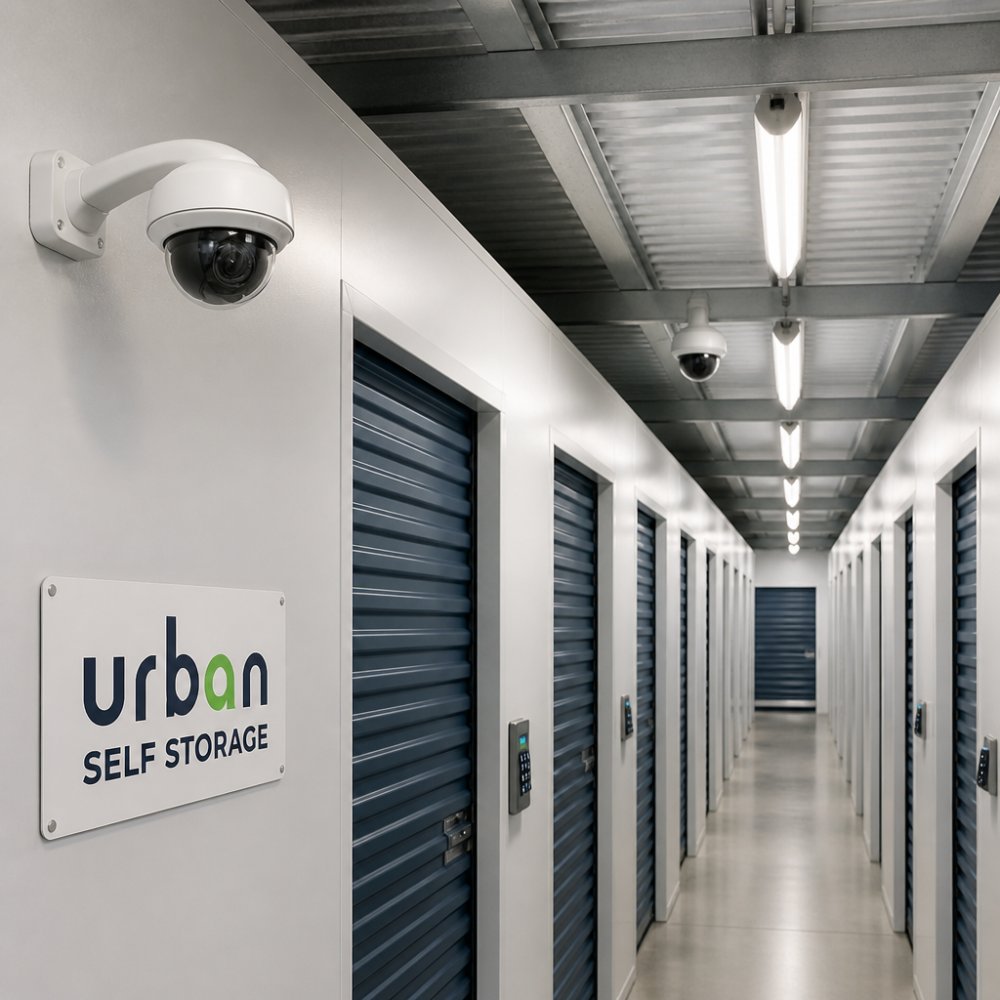
Underwriters typically require minimum 1080p (Full HD) resolution for entry points, corridors, and common areas; 4K preferred for high-value zones. Wide-angle lenses (90-120 degrees) must eliminate blind spots, with overlapping coverage across all corridors.
24/7 continuous recording is required (not motion-triggered alone), with minimum 30-day retention and cloud backup or redundant storage. Footage must be timestamped with synchronised clocks.
Infrared or thermal imaging is required for outdoor perimeters and unlit areas, with colour night vision capability preferred for identification.
Book Online in 3 Minutes & Get 50% Off Instantly →
Real-time motion detection with immediate alerts, remote access for staff, and integration with access control systems (so timestamps align with PIN entries) are required.
Access Control and PIN Code Systems
Individual PIN codes and electronic access logs are equally important to CCTV, creating an irrefutable record of who accessed each unit and when.
How to Reduce Storage Insurance Costs Through Risk Assessment
Keep records of CCTV installation, servicing, and upgrades. Provide this documentation at renewal to demonstrate commitment to loss prevention.
The Claims Process When CCTV Evidence Is Available
CCTV footage does not automatically guarantee claim approval. Insurers use surveillance as one piece of evidence within a broader investigation.
How Insurers Use CCTV Footage in Claims Investigation
When a claim is filed, the adjuster requests CCTV footage (24 hours before and after loss discovery), access control logs, tenant statement, photographs of the unit and damage, police report (if applicable), and facility maintenance records.
When CCTV Evidence Strengthens a Claim
Claims are approved faster and for full value when:
- Footage clearly shows a break-in. A thief forcing a lock, breaking a door, or cutting a seal is objective evidence of theft, not tenant negligence.
- Footage shows unauthorised access. Someone entering the unit without a valid PIN code (or with a code not assigned to them) proves the loss was not the tenant’s fault.
- Access logs match the footage. The person shown entering the unit in the video corresponds to the access log entry, confirming their identity and time.
- The loss window is narrow. Footage showing the unit secure on Monday and the theft discovered Tuesday creates a clear 24-hour window, making investigation straightforward.
- The footage is high-definition. Clear images allow the adjuster to rule out ambiguity and support police investigation if needed.
When CCTV Evidence Weakens or Fails a Claim
Claims are denied or reduced when:
- Footage shows the tenant’s PIN code was used. If the access log shows the tenant (or someone with their code) entered the unit shortly before the loss was discovered, the insurer may argue the tenant is responsible for securing their belongings or that the loss is not covered (e.g., if items were removed by the tenant themselves).
- Footage is missing or corrupted. If the facility’s CCTV system failed, did not record during the relevant period, or the footage was overwritten before the claim was filed, the insurer cannot verify the loss. Without objective evidence, the claim relies solely on the tenant’s account, which is weaker.
- The loss window is too wide. If the tenant cannot pinpoint when items were last seen, the loss could have occurred days or weeks earlier. The adjuster may deny the claim if they cannot establish when the theft occurred.
- Footage shows negligence by the tenant. If video shows the tenant leaving a unit door propped open, or leaving valuables visible through a window, the insurer may deny the claim or reduce the payout, arguing the tenant failed to take reasonable care.
- Footage shows negligence by the facility. If video shows a broken camera, an unlocked gate, or staff failing to respond to an alarm, the insurer may deny the claim and instead pursue a claim against the facility’s liability insurance.
- The footage is low-resolution or unclear. Blurry images, poor lighting, or obscured views do not help the adjuster investigate. Without clear evidence, the claim is treated as unverified.
The Role of Access Control Logs in Claims Decisions
Access control logs are often more decisive than CCTV footage. If the log shows no entry to the unit during the loss window, it proves unauthorised access (break-in). If the log shows only the tenant’s PIN code was used, it suggests the tenant is responsible for securing their belongings.
Claims Outcomes: Facility Liability vs. Tenant Coverage
It is important to understand that CCTV protects the facility operator’s liability, not necessarily the tenant’s belongings.
-
For the facility: Clear CCTV footage showing that reasonable security measures were in place (cameras, access control, lighting) protects the facility’s liability insurance. If a theft occurs despite these measures, the footage demonstrates the facility took appropriate precautions. This reduces the risk of a lawsuit from the tenant claiming the facility was negligent.
-
For the tenant: CCTV footage proves what happened, but it does not automatically mean the tenant’s loss is covered. The tenant’s personal contents insurance policy determines whether the loss is reimbursed. If the policy excludes storage units, or if the policy has a low limit, the tenant may not recover the full value of their loss even with clear CCTV evidence.
What CCTV Monitoring Does and Doesn’t Cover
CCTV is powerful but has clear limits. Understanding what surveillance does and doesn’t do prevents false expectations.
CCTV does:
- Deter theft and vandalism through visible cameras
- Provide evidence for insurance claims
- Create an audit trail of who accessed each unit
- Alert management to break-ins in progress
- Support law enforcement investigations
- Reduce overall facility liability
CCTV does not:
- Prevent all theft (determined thieves can still target units)
- Guarantee recovery of stolen items
- Cover damage caused by facility negligence
- Protect against fire or natural disasters
- Eliminate the need for tenant contents insurance
- Guarantee police will recover stolen property
Conclusion
CCTV systems directly influence self-storage insurance premiums and coverage terms. Facilities with modern, high-definition surveillance and strong access control systems receive better rates and broader coverage from underwriters. The investment in security infrastructure reduces risk, which insurers reward with lower premiums and more favourable policy terms.
Frequently Asked Questions
Does having CCTV reduce self-storage insurance premiums?
Yes, CCTV surveillance is one of the primary factors insurers assess when calculating premiums for storage facilities. High-definition cameras with 24/7 monitoring and remote access capability significantly reduce risk profiles. Facilities with documented surveillance systems typically qualify for lower underwriting rates because CCTV demonstrates active loss mitigation and provides evidence for claims investigation. The premium reduction depends on camera specifications, coverage area, and monitoring protocols.
What security features do insurers look for to lower storage insurance costs?
Insurers evaluate multiple security layers: high-definition CCTV with adequate perimeter and interior coverage, access control systems using PIN codes or electronic locks, 24/7 monitoring protocols, secure entry gates, adequate lighting, and documented security procedures. Facilities combining multiple features demonstrate superior risk management and qualify for better premium rates. Individual tenant access logs and individualized PIN codes are particularly valued because they create accountability and simplify the claims process when theft or vandalism occurs.
Are items in a CCTV-monitored storage unit automatically covered for theft?
Not automatically. CCTV presence reduces insurance premiums and strengthens claims investigations, but coverage depends on your policy terms and contents documentation. Facility-provided CCTV helps establish evidence for theft claims, but you must have valid contents insurance in place. Policy exclusions, coverage limits, and deductibles still apply. Having CCTV footage available speeds up claims assessment and can support your case, but the insurance provider ultimately determines coverage based on policy language and claim circumstances.
How does CCTV footage help with the self-storage claims process?
CCTV footage serves as critical evidence during claims investigation. When theft or vandalism occurs, recorded footage documents the incident, time of occurrence, and circumstances. This evidence supports your claim narrative, helps insurers assess liability, and can identify responsible parties. Facilities with high-definition cameras and proper retention policies can provide clear footage to investigators. Remote monitoring capabilities mean incidents are often detected quickly, improving response times. Documented evidence typically accelerates claims processing and increases the likelihood of claim approval, reducing settlement delays.