
Last Updated: October 22, 2026
Quick Summary
24-hour storage access matters most for shift workers, tradies, market stallholders and online sellers who operate outside standard business hours and need unpredictable access to stock, tools or inventory. For occasional users storing furniture or downsizing temporarily, extended hours (6 AM to 9 PM) usually offer better value, and 24-hour storage access rarely justifies the premium cost.
- Shift workers, FIFO employees, tradies and event planners benefit most from 24-hour storage access because their schedules don’t align with business hours.
- Extended hours (6 AM to 9 PM) provide a practical middle ground for most users and cost less than true 24/7 access.
- Ask whether gate hours and office hours differ, you may access your unit 24/7 but find no staff available if your access code fails after hours.
- Track your actual visits over four weeks; if fewer than two fall outside extended hours, the 24-hour premium likely isn’t worth it.
- After-hours visits carry personal safety risks in industrial areas, so visit during daylight when possible and never alone late at night.
Table of Contents
- Does 24-Hour Storage Access Actually Matter?
- Understanding Self Storage Access Hours
- Who Benefits Most from 24-Hour Access
- Business Storage Access: When Round-the-Clock Matters
- Self Storage Security and Access Control Systems
- 24-Hour Access Versus Standard Hours: Cost and Flexibility Trade-offs
- Questions to Ask Before Choosing a Facility
- Frequently Asked Questions
Does 24-Hour Storage Access Actually Matter?
Not every facility needs 24-hour access. The real question is whether you’ll actually use it.
For shift workers, tradies, market stallholders and online sellers, round-the-clock access is essential, you retrieve stock, tools or inventory on unpredictable schedules that business hours don’t accommodate.
This guide from Urban Self Storage breaks down who genuinely benefits from 24-hour storage access, what it actually costs, and the security trade-offs to understand before choosing.
Understanding Self Storage Access Hours
Self-storage facilities offer three main access models, each with different flexibility and security implications.
24/7 Access means you can enter your unit any time, day or night, seven days a week. The gate, lift, and individual unit remain accessible around the clock. You use a PIN code, keypad entry, or app-based system to gain entry. No staff member needs to be present.
Extended Hours typically run from early morning (6 or 7 AM) until late evening (8 or 9 PM), covering most working schedules without the cost of true 24/7 operation.
Business Hours Only restricts access to standard office times: usually 9 AM to 5 PM, Monday to Friday.
24/7 Access Versus Extended Hours Versus Business Hours
The choice between these models affects cost, convenience, and how you use your storage.
| Access Type | Best For | Security Features | Flexibility | Typical Cost |
|---|---|---|---|---|
| 24/7 Access | Shift workers, tradies, online sellers, frequent visitors | CCTV, keypad entry, access logs, motion-activated lighting | Retrieve belongings any time | Higher |
| Extended Hours (6 AM-9 PM) | Working professionals, regular users | CCTV, keypad entry, some after-hours patrols | Early morning and evening access | Moderate |
| Business Hours Only (9 AM-5 PM) | Occasional users, furniture storage, downsizers | CCTV, manned reception, staff oversight | Limited, requires planning | Lower |
For most users, extended hours offer a practical middle ground, access before work, during lunch or after 5 PM without paying for overnight access you won’t use. If your schedule is truly unpredictable, rotating shifts, a market stall or an online business, 24-hour access eliminates the stress of planning around facility hours.
Gate Hours Versus Office Hours: What’s the Difference?
This distinction matters more than many facilities explain.
Gate hours control when you can physically enter the facility. If the gate is locked at 6 PM, you cannot drive in, regardless of whether your unit has electronic access.
Office hours are when staff are present to handle inquiries, process new rentals and manage disputes. Many facilities with 24/7 gate access run office hours from 9 AM to 5 PM.
Who Benefits Most from 24-Hour Access
Certain professions and business models rely on unpredictable or non-standard schedules. For these users, 24-hour access is not a luxury, it’s essential infrastructure.
Shift Workers and FIFO Employees
Shift workers and FIFO (Fly-In/Fly-Out) employees operate outside standard business hours, often on nights, rotating rosters or irregular patterns that don’t align with 9-to-5 facility access.
If you’re a nurse, security guard or hospitality worker storing items during a relocation, you need access when your shift finishes, often late evening or early morning.
For these groups, 24-hour access eliminates friction. You visit when your schedule permits, not when the facility decides.
If you work shifts, ask the facility whether their 24/7 access includes public holidays. Some facilities restrict access during Christmas or New Year, exactly when you might need to retrieve items before heading away.
Tradies, Event Planners, and Market Stallholders
Tradies and contractors move between job sites with tools and materials, collecting equipment at 5 AM before a site start or dropping off materials at 7 PM.
For these professionals, 24-hour storage access isn’t optional, it’s how you operate. You can’t tell a client you’ll deliver next week because the facility is closed, or wait until Tuesday morning to collect equipment for a Saturday event.
Book Online in 3 Minutes & Get 50% Off Instantly →
Extended hours help, but 24/7 access removes the constraint entirely. You work your schedule; the facility accommodates it.
E-Commerce and Online Sellers
Online sellers using storage for inventory face unpredictable demand, a bulk order at 9 PM may need picking and packing overnight, and peak trading periods (Christmas, Black Friday, back-to-school) demand irregular hours to meet delivery deadlines.
If your inventory sits in a storage unit, 24-hour access lets you manage stock without coordinating with facility hours. You pack orders when demand requires, not when the gate opens.
Business Storage Access: When Round-the-Clock Matters
Business storage needs differ from residential storage. Most businesses operate outside standard hours at least some of the time.
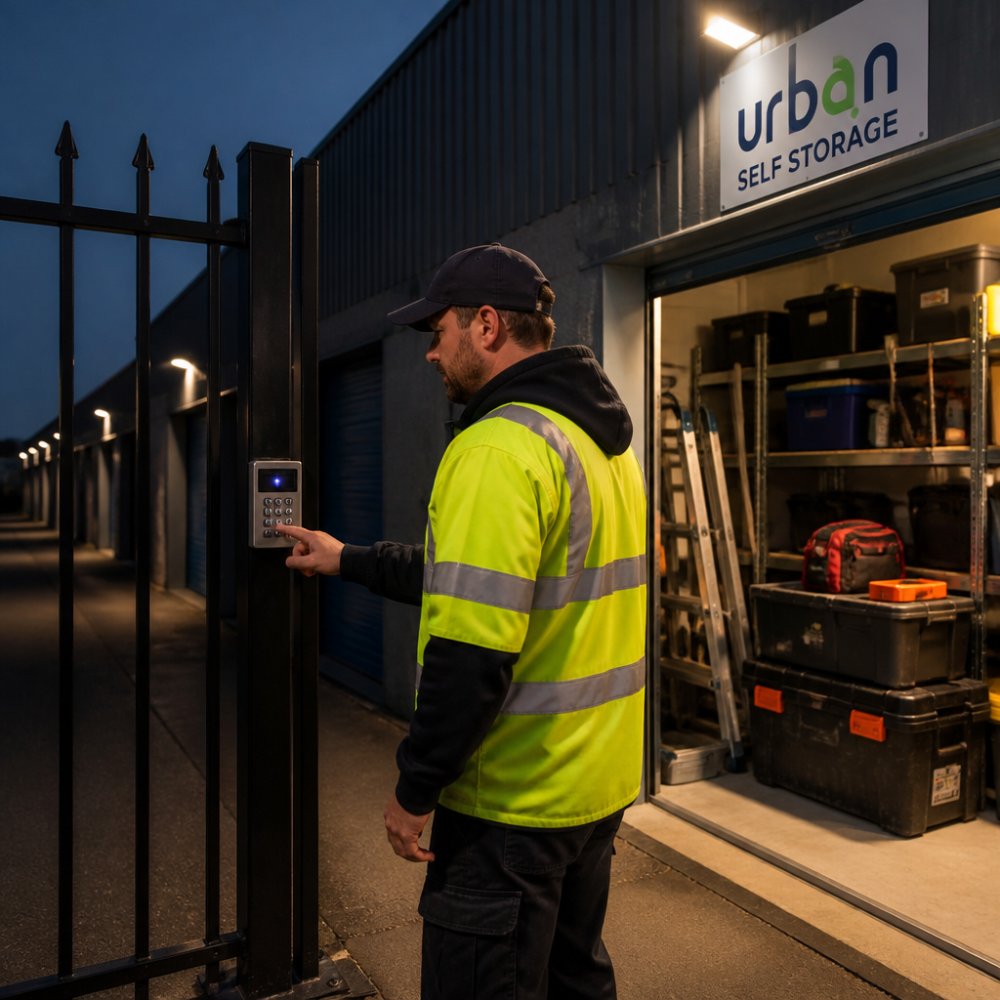
Small to medium businesses storing excess inventory, seasonal stock or equipment need flexible access.
For businesses, 24-hour access often justifies its cost. The alternative, paying staff to visit during business hours, rescheduling jobs, or delaying operations, costs more than the premium for round-the-clock access.
However, ask whether your business genuinely needs 24/7 access or whether extended hours (6 AM to 9 PM) cover 95% of your requirements. Many business owners pay for 24-hour access but use it only a few times per month; if you mostly visit during business hours with occasional evening or early-morning trips, extended hours deliver the same practical benefit at lower cost.
Urban Self Storage offers flexible short and long-term business storage options designed for operations that need accessible facilities.
Calculate your true access pattern before committing to 24/7 access. Track when you actually need to visit your storage unit over a month. If 80% of visits fit within extended hours, the premium for 24/7 access may not be worth it.
Self Storage Security and Access Control Systems
24-hour access introduces a trade-off: convenience versus security oversight. Understanding how facilities maintain security during after-hours access is critical.
CCTV, Access Codes, and PIN Entry Systems
Modern facilities use layered security during 24/7 access. CCTV monitors the facility continuously, recording all entry and exit; access codes or PIN entry create a log of who entered and when; motion-activated lighting illuminates areas as people move through.
These systems work, but they’re reactive. A camera records a breach; it doesn’t prevent one.
Ask your facility: how is CCTV monitored, in real time or only after an incident? Are access logs reviewed regularly or only when a problem is reported?
Urban Self Storage uses advanced 24/7 CCTV surveillance across its facilities, with secure access control systems to protect your belongings around the clock.
Safety Considerations for After-Hours Visits
Visiting a storage facility alone at night introduces personal safety risks that business-hours access doesn’t.
You’re in an industrial area, often isolated, with limited lighting outside the facility. If your vehicle breaks down, you fall or someone approaches you, staff aren’t present to help, you’re relying on CCTV and emergency contacts, which is slower than having staff on-site.
Some practical considerations:
- Visit during daylight when possible, even if 24/7 access is available
- Bring another person if you’re visiting late at night
- Ensure your mobile phone is charged
A facility’s security features matter, but your own precautions matter more. 24-hour access is convenient, but it doesn’t eliminate the inherent risks of visiting an industrial site alone after dark.
Never visit a storage unit alone late at night if you can avoid it. If your business requires after-hours access, consider whether extended hours (until 8 or 9 PM) would be safer and still meet your needs.
24-Hour Access Versus Standard Hours: Cost and Flexibility Trade-offs
The premium for 24-hour access varies, but it’s meaningful. Some facilities charge an additional monthly fee; others include it in base rent but at a higher overall rate.
The cost-versus-benefit calculation depends on your actual usage pattern.
When 24-hour access makes financial sense:
Book Online in 3 Minutes & Get 50% Off Instantly →
- You visit your unit multiple times per week outside business hours
- Your business operates outside standard hours and genuinely needs after-hours access
- The cost of restricted access (paying staff overtime, delaying operations, losing sales) exceeds the storage premium
When extended hours are more cost-effective:
- You visit occasionally and can plan visits during extended hours
- You work shifts but can adjust timing to visit before or after work
- The premium for 24/7 access sits unused most months
Track your access pattern for four weeks and count visits outside extended hours (say, 6 AM to 9 PM). If fewer than two visits per month require 24/7 access, the premium likely isn’t justified.
Contact Urban Self Storage for a quote on your specific needs, our competitive pricing reflects the flexibility you actually require.
Questions to Ask Before Choosing a Facility
Before committing to 24-hour access, ask these specific questions:
-
Are 24/7 hours truly unrestricted? Some facilities claim 24/7 access but restrict it on public holidays, during maintenance, or during emergencies. Ask for their policy in writing.
-
Is there an after-hours access fee? Some facilities charge per visit after business hours, or a monthly premium. Understand the full cost before signing.
-
What happens if my access code fails at 2 AM? Is there a 24-hour emergency contact? Will they charge a callout fee to reset your access?
-
How is CCTV monitored? Is someone watching live, or is footage reviewed only if you report a problem?
-
What are gate hours versus office hours? Can you access the grounds 24/7, or just during extended hours? If the gate closes at 6 PM, 24/7 unit access is irrelevant.
-
Are there access restrictions on public holidays or during maintenance? Christmas, New Year, and other holidays might have reduced access or closures.
-
What’s the cost difference between extended hours and 24/7 access? Calculate whether the premium justifies your actual usage.
-
Can I visit with another person, or is solo access only? Some facilities restrict who can access your unit after hours for security reasons.
-
What happens if I fall behind on rent? Do they restrict access immediately, or give you time to catch up? After-hours access might be suspended if your account is overdue.
-
Is the facility well-lit after dark? Motion-activated lighting helps, but ask whether all areas are covered.
24-hour storage access matters if your schedule demands it. For shift workers, tradies, event planners, and online sellers, round-the-clock access removes operational constraints and lets you work on your timeline.
The key is matching access hours to your actual needs, not paying for convenience you won’t use. Ask specific questions about how 24/7 access works at your chosen facility, gate hours, emergency contacts, cost, and security monitoring.
Frequently Asked Questions
Do self storage units have 24-hour access?
Not all facilities offer 24-hour access. Many provide extended hours (early morning to late evening) or business hours only. Some facilities offer 24/7 access through keypad or PIN entry systems that allow you to enter the gate and access your unit at any time, while others restrict access to staffed office hours or by appointment. Always confirm the exact access hours with your chosen facility before signing a lease, as this varies significantly between providers.
Is 24/7 storage access worth it for my business?
24-hour access matters most if you operate irregular hours, work shifts, or need to retrieve stock or equipment outside standard business hours. Tradies, event planners, FIFO workers, and online sellers often find round-the-clock access essential for their workflow. If you rarely need evening or weekend access, standard business hours storage may be sufficient and could cost less. Assess how often you genuinely need after-hours entry before paying for premium access you won’t use.
What should I ask a storage facility about after-hours access?
Ask whether 24-hour access is truly unrestricted or limited to certain days (e.g., no public holidays). Confirm whether there are additional fees for after-hours visits or for using keypad entry. Ask how access is monitored (CCTV, access logs) and whether lighting is adequate for safe evening visits. Check what happens to your access if rent falls overdue, and whether you need separate insurance for after-hours retrieval. Request a tour during evening hours to assess security and lighting firsthand.
Is 24-hour access to storage units safe?
Safety depends on the facility’s security measures. Look for facilities with 24/7 CCTV surveillance, well-lit access routes, secure keypad or PIN entry systems that log all visits, and individual unit alarms. Visit the facility during evening hours to assess lighting and overall environment. Facilities with active security patrols or monitoring services offer additional peace of mind. Always inform someone of your visit timing, avoid very late-night visits alone, and choose facilities in accessible locations rather than isolated areas.