
Last Updated: November 7, 2026
Quick Summary
Drive-up access storage for boat trailers lets you park your trailer directly in front of a ground-level bay with a roller door, so you avoid carrying gear through corridors. Before booking, measure the full rig, including the hitch, plus its height with the boat loaded, and confirm the door opening and apron space.
- Measure the full combination, including boat, trailer, hitch and tow ball, not just the boat.
- Allow at least 300 mm clearance above the highest point and on each side at the widest point.
- Confirm the door opening dimensions separately, since the door is often the limiting size.
- Check the apron depth in front of the bay so you can reverse the rig in safely.
- CCTV records incidents but does not guarantee protection, so confirm your own insurance cover in writing.
Table of Contents
- What Drive-Up Access Storage Means for a Boat Trailer
- How Much Space Do I Need to Store a Boat Trailer?
- Drive-Up Versus Other Storage Types
- Security, Access Hours and What They Do Not Guarantee
- Boat Trailer Storage Checklist Before You Book
- Preparing Your Boat and Trailer for Long-Term Storage
- Booking Your Drive-Up Unit With Urban Self Storage
- Frequently Asked Questions
What Drive-Up Access Storage Means for a Boat Trailer
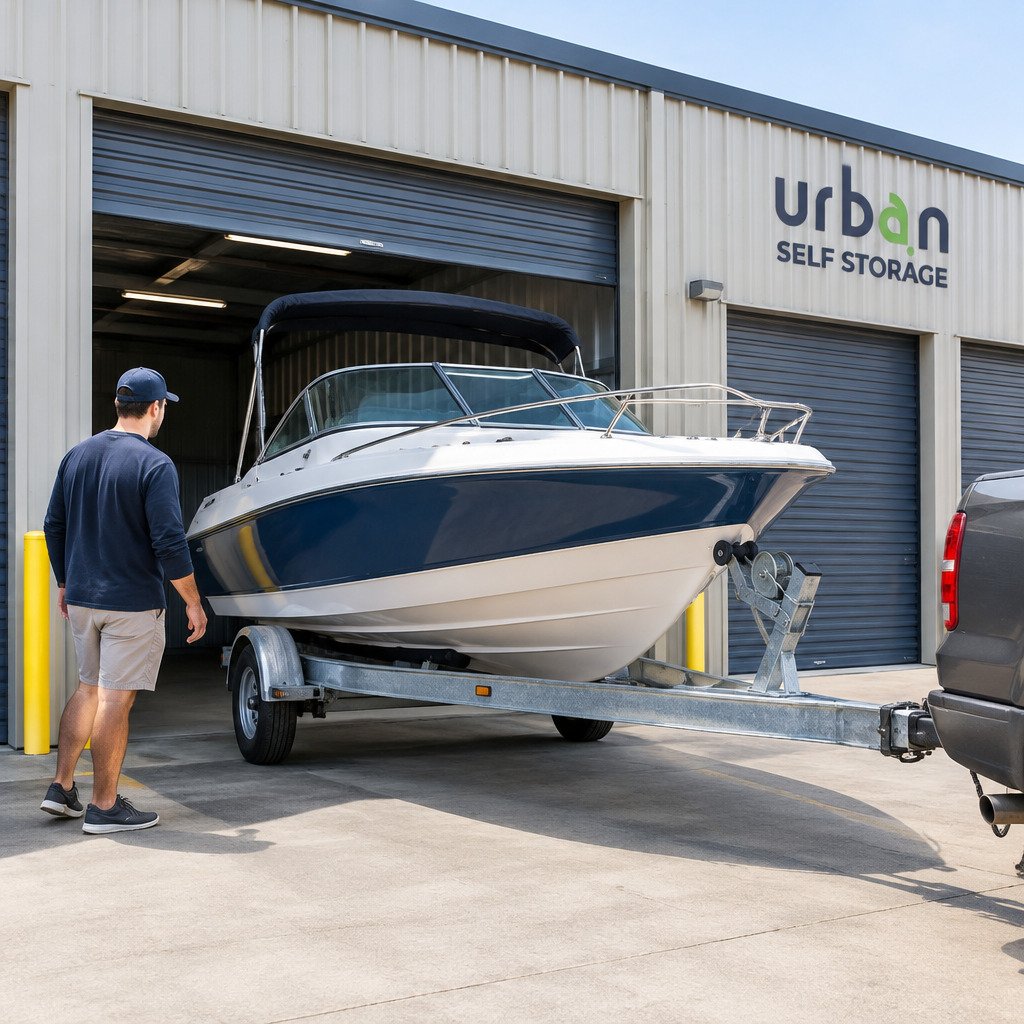
Drive-up access storage for boat trailers lets you park your trailer directly in front of your storage bay, rather than carrying gear through a corridor or lifting it onto shelves.
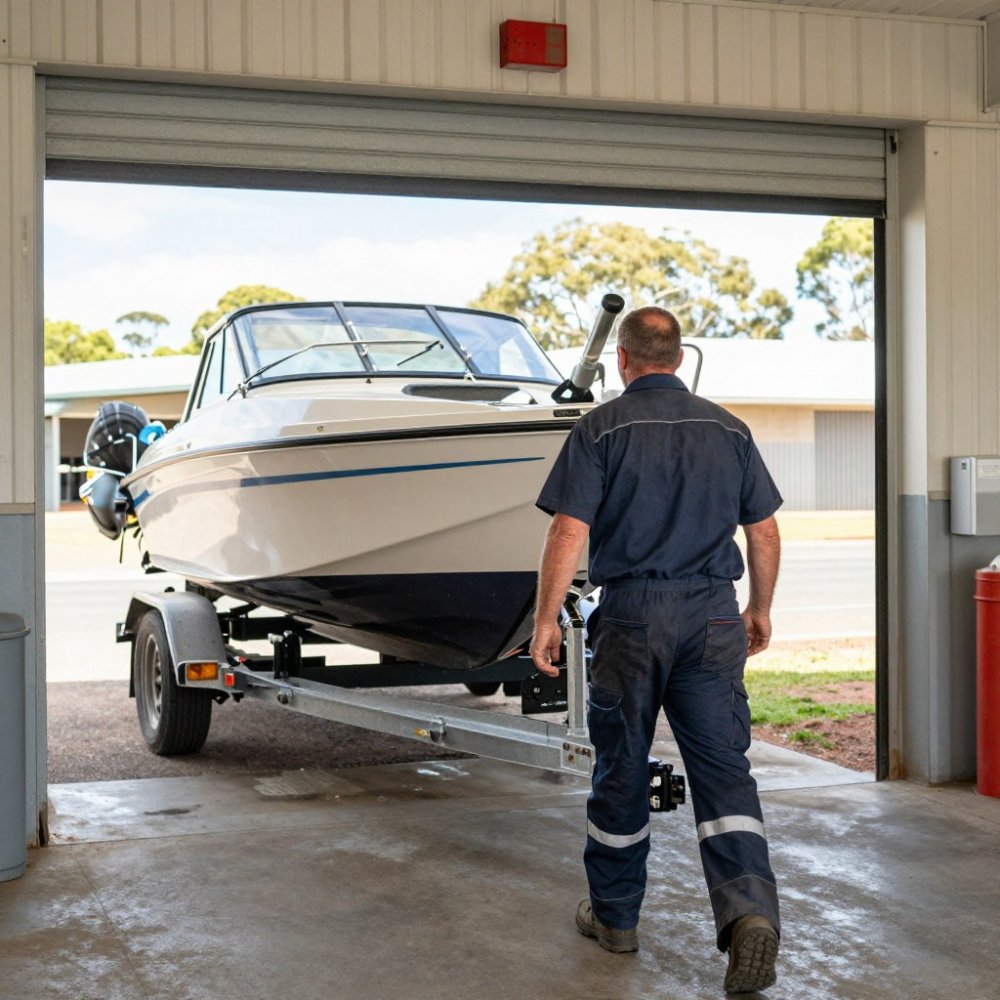
A drive-up unit is typically a ground-level bay with a roller door opening straight onto a driveway or hardstand. You reverse in, unhitch, and leave the trailer where it sits.
Before you book anything, check three things: the trailer’s overall length including the hitch, its height with the boat on board, and whether you need to reverse in or can drive straight through. Those details decide which unit will actually fit, and they matter more than the advertised square metres.
How Much Space Do I Need to Store a Boat Trailer?
Most boat owners underestimate the space they need because they measure the boat and forget the trailer. Measure the full combination, boat, trailer, hitch and tow ball, then add room to open the roller door and manoeuvre out.
Plan for clearance on every side, not just the length. You need room to step around the trailer, open a boat cover, and reach stored gear.
A Practical Measuring Method
Use a tape measure and a notepad, and take the measurements with the boat sitting on the trailer on level ground, hitched to the tow vehicle if possible, since drive-up access storage for boat trailers is only practical once you know your exact footprint. Record these numbers:
- Overall length from the front of the coupling (or the tow ball) to the rear-most point of the trailer or boat, including any outboard motor or boarding ladder.
- Overall width at the widest point, which is usually the trailer guards or the boat’s beam, not the trailer frame.
- Overall height at the highest point with the boat loaded, including bimini, rocket launchers, antennas or any tower.
- Coupling height from the ground to the top of the coupling, which affects how the trailer sits when unhitched.
- Wheel track across the outside of the tyres, which determines how the trailer tracks when reversing.
Keep the numbers on your phone. When you enquire, give the facility these figures rather than the boat’s advertised length, because manufacturer specifications often exclude the trailer and motor.
Door Opening, Bay Dimensions and Clearance
The door is usually the limiting dimension, not the bay itself. A roller door opening is narrower and lower than the bay behind it, and the track and overhead lights reduce clearance further.
As a rule of thumb, allow at least 300 mm of clearance above the highest point and 300 mm on each side at the widest point. That margin covers suspension movement, loading variation and imperfect reversing.
Turning Radius and Reversing Room
Reversing a trailer into a bay is the step most people underestimate. Your turning radius depends on the length of the tow vehicle, the length of the trailer, and the angle of the hitch.
A common pattern is that a rig that fits the bay comfortably still cannot be reversed in because the apron is too short or the approach is blocked.
Worked Example
Suppose your boat and trailer measure 6.2 m overall, 2.3 m wide at the guards, and 2.6 m high with the bimini up. Add 300 mm clearance on each side and above, and you need a door opening of at least 2.9 m wide and 2.9 m high, plus a bay long enough to leave room at the rear. If the bimini folds down to 2.1 m, the same rig may fit a bay with a 2.4 m door.
What to Ask the Facility
Before you book, ask for the internal bay dimensions, the door opening dimensions, the apron depth in front of the bay, and whether the bay is level or sloped. A sloped bay can make unhitching and re-hitching harder, especially with a heavy trailer. Also ask whether posts, drains or services inside the bay reduce usable space.
Drive-Up Versus Other Storage Types
Drive-up units suit boats, caravans and trailers because the vehicle stays outside the building.
The right choice comes down to a few questions. How often will you visit? How exposed is the site to sun and rain?
Check what each option includes. Some drive-up bays come with hardstand parking directly outside, while others expect you to park on a shared apron.
Security, Access Hours and What They Do Not Guarantee
Security features help, but they do not remove all risk. Urban Self Storage advertises advanced 24/7 CCTV surveillance, which deters casual interference and provides a record if something goes wrong. Understanding what each feature actually does is more useful than a list of logos on a brochure.
What Security Features Do and Do Not Guarantee
- CCTV records activity and can support an investigation, but it does not physically stop someone entering a site. Coverage varies by camera position, lighting and recording retention.
No facility can guarantee that nothing will happen to your property. Cameras record incidents rather than prevent every one, and a storage agreement typically sets out the limits of the facility’s responsibility. Read those terms rather than assuming CCTV means the facility insures your boat.
Insurance and Liability: Questions to Ask
Your boat and trailer are your responsibility to insure unless your storage agreement says otherwise. Before you sign, ask the facility:
- Does the agreement require me to hold my own insurance for the boat and trailer?
- Does the facility’s insurance cover stored property, and if so, under what circumstances?
- What exclusions apply, for example, damage from weather, pests, or my own manoeuvring?
- What is the process for reporting an incident, and what records does the facility keep?
Then check your own policy. Many marine and trailer policies cover the boat while stored, but cover can depend on whether the storage is secured, whether the trailer is coupled or unhitched, and whether the boat is under cover. Ring your insurer, describe the arrangement in plain terms, drive-up bay, roller door, gated site, and ask them to confirm cover in writing if you are unsure.
Access Hours and After-Hours Use
Access hours matter as much as security. If you intend to visit at short notice or on weekends, confirm opening hours and whether you can reach your bay outside standard trading times.
Also ask how access works in practice: do you use a keypad, a fob, or a smartphone app, and what happens if you lose it or your phone battery goes flat?
Practical Steps Before You Store
Remove valuables such as electronics, fishing gear and removable accessories before storing. Record your boat’s hull identification number, trailer serial number and any distinguishing marks, and photograph the rig from several angles. Finally, walk the site at the time of day you expect to visit and note the lighting, gate operation and any blind spots, that is the most honest security assessment you can make.
Boat Trailer Storage Checklist Before You Book
Use this checklist before you commit to a unit:
- Overall length measured, including hitch and tow ball
- Trailer width and wheel track measured
- Boat height with trailer measured at the highest point
- Roller door opening height and width confirmed
- Apron or hardstand space in front of the bay checked
- Reversing route planned and practised
- Access hours confirmed for the times you expect to visit
- Security features understood, including what they do not cover
Working through this list before booking prevents most common regrets, such as discovering the boat will not clear the door or that the apron is too narrow to reverse safely.
Preparing Your Boat and Trailer for Long-Term Storage
Storing a boat for several months needs more preparation than parking a car.
Drain the engine cooling system and fuel where the manufacturer recommends, and fit a fresh fuel stabiliser for extended storage.
Cover the boat with a breathable cover rather than plastic, which traps moisture. Ventilation reduces mould and mildew.
Storing a boat for several months needs more preparation than parking a car.
| Task | What to do | Note |
|---|---|---|
| Clean and empty | Clean the hull and remove food, wet gear and personal items | Prevents pests and odours |
| Dry interior | Dry the interior thoroughly before closing hatches | Done before closing any hatches |
| Engine and fuel | Drain cooling system and fuel where the manufacturer recommends | Fit fresh fuel stabiliser for extended storage |
| Battery | Disconnect the battery or fit a maintainer | Protects battery over storage |
| Trailer tyres | Check tyre pressures and lift trailer slightly off wheels | Reduces flat spotting |
| Cover | Use a breathable cover, not plastic | Plastic traps moisture |
| Ventilation | Allow airflow to reduce mould and mildew | Ventilation is key |
| Final checks | Lubricate winch, check lights and coupling, remove loose accessories | Keep valuable accessories safe |
Booking Your Drive-Up Unit With Urban Self Storage
Once you have measured your rig and worked through the checklist, you are ready to book. Urban Self Storage offers caravan and boat storage in Bunbury, with multiple unit sizes to suit different combinations.
We recommend measuring twice before you confirm, especially the door opening and the height with the boat on the trailer. For a deeper look, our Find the Right Storage Unit Size guide walks through each measurement step by step.
If you are weighing up size options for a caravan or trailer, the 7 Steps to Choose the Right Caravan Storage Unit Size guide covers the decision in detail. For local context on protecting your gear, read Caravan and Boat Storage in Bunbury: How to Protect Your Gear, and to understand what the access system does and does not cover, see Remote Access Storage Unit Security Features Guide. Our Best Secure Self Storage Bunbury Decision Guide helps you weigh the choices before committing.
Book your unit with Urban Self Storage today and enjoy secure, convenient access whenever you need it.
Frequently Asked Questions
What is drive-up access storage for a boat trailer?
Drive-up access storage is a unit or bay you can drive a vehicle and trailer into directly, usually through a roller door at ground level, if the unit you choose offers this. You do not need to unhitch the trailer or unload the boat to store it. For a boat trailer, the key checks are the door opening height and width, the depth of the bay, and whether there is enough room to turn and reverse in the driveway. Confirm these measurements with Urban Self Storage before you book, as sizes vary between units.
How much space do I need to store a boat trailer?
Measure the full length of the boat and trailer together, including the tow hitch and any ladder or motor that extends past the hull. Add a clearance margin on each side so you can open doors and move around the trailer. Also measure the total height with the boat on the trailer, since roller door openings are often the limiting factor. Check the unit dimensions on the Urban Self Storage website or ask the team to confirm the fit against your exact measurements.
Can I store a boat and trailer in a drive-up storage unit?
In many cases, yes, provided the unit is large enough and the door opening clears the boat’s height. Ask Urban Self Storage whether the unit you are considering is suitable for a boat and trailer combination.
How do I prepare a boat trailer for long-term storage?
Rinse the boat and trailer to remove salt and debris, let them dry fully, and check the bearings, tyres and lights. Keep the trailer off its tyres if you can to reduce flat spots. Cover the boat if the unit is not fully enclosed. Inspect the trailer periodically during storage, for example every few months, and check for leaks, pests or damp. Check the site rules for boat storage with Urban Self Storage before you book.
