

Table of Contents
- Understanding CCTV Monitored Storage Unit Benefits
- How 24/7 Surveillance Storage Australia Deters Theft and Vandalism
- Real-Time Alerts and Remote Monitoring for Tenant Peace of Mind
- Access Control Storage Units Australia: Integration with Security Infrastructure
- Evidence Collection and Incident Response
- Secure Self Storage Australia: Liability Reduction for Facility Owners
- Storage Unit Insurance Australia and Premium Discounts
- Cybersecurity of Camera Feeds and Privacy Compliance
Last Updated: July 23, 2026
Understanding CCTV Monitored Storage Unit Benefits
CCTV monitored storage unit benefits represent one of the most effective security investments available to facility owners and tenants. Modern surveillance creates a documented security layer that protects assets, reduces liability exposure, and enables rapid incident response. Unlike traditional security approaches relying solely on physical barriers, monitored systems provide continuous oversight and evidence collection capabilities.
What makes this technology particularly valuable is the accountability it creates. When CCTV monitored storage unit benefits are properly implemented, every access point becomes documented. Tenants know their belongings are protected by continuous observation. Facility owners gain documented proof of their security diligence. This transparency builds the foundation for trust that drives customer retention and operational efficiency.
How 24/7 Surveillance Storage Australia Deters Theft and Vandalism
The deterrent effect of 24/7 surveillance storage Australia operates on a simple principle: potential offenders avoid locations where their actions will be recorded and documented. Professional thieves and opportunistic vandals make calculated decisions about target selection. When they observe visible CCTV cameras, professional-grade lighting, and clear evidence of monitoring systems, the risk-to-reward calculation shifts dramatically.
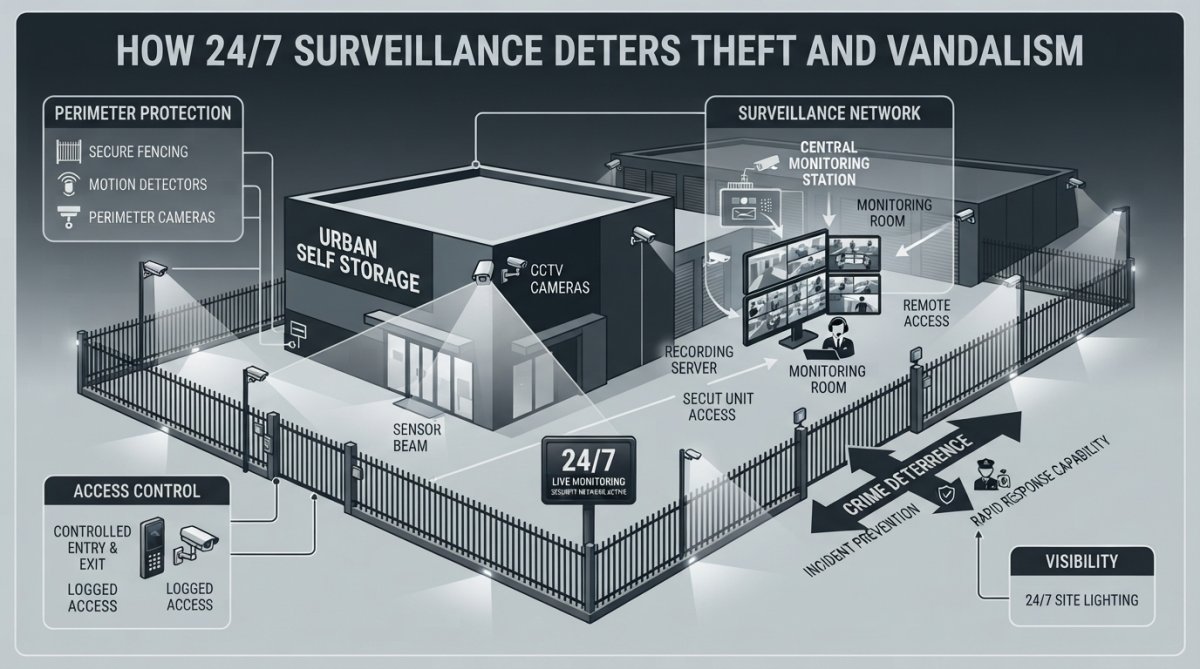
The visibility of your security system matters as much as its actual functionality. Cameras positioned at key entry points, clear signage indicating 24/7 surveillance, and professional lighting all communicate that the facility takes security seriously. This combination creates a powerful deterrent before any actual incident occurs.
Real-world patterns confirm this effect. Facilities implementing comprehensive surveillance systems consistently report lower incident rates. Vandalism decreases because potential offenders know their actions will be documented. Break-in attempts decline because the risk profile changes fundamentally.
Position CCTV cameras at all primary entry points and along perimeter fencing. Make the camera presence obvious, visible cameras deter more effectively than hidden ones. Pair cameras with clear signage stating “24/7 CCTV Surveillance” to maximize the psychological deterrent effect.
Real-Time Alerts and Remote Monitoring for Tenant Peace of Mind
Remote monitoring capabilities fundamentally change how tenants experience their storage rental. Rather than wondering whether their belongings remain secure, tenants gain direct visibility into facility security status and access events. Real-time alert systems notify facility managers immediately when unauthorized access attempts occur or unusual activity is detected.
Modern cloud-based surveillance systems enable facility managers to monitor operations from anywhere. If a manager receives an alert about unusual activity, they can immediately access live footage, assess the situation, and contact authorities if necessary. This capability transforms response times from hours to minutes.
For tenants storing business inventory, equipment, or valuable personal items, this real-time monitoring provides operational confidence. They know that if something happens to their unit, the incident will be documented immediately with clear video evidence.
Real-time monitoring means facility staff can respond to incidents within minutes rather than discovering problems hours or days later. This speed difference separates minor incidents from catastrophic losses.
Access Control Storage Units Australia: Integration with Security Infrastructure
Access control storage units Australia represent the convergence of physical security and digital oversight. When CCTV systems integrate with gated access infrastructure, every entry becomes both documented and controlled. A tenant accessing their unit is documented on video. An unauthorized person attempting entry is both blocked by the gate and recorded by cameras if they breach it.
The integration becomes particularly valuable when investigating incidents. If a unit is breached, facility managers can review access logs to determine exactly when the breach occurred, who had authorized access during that period, and what the video shows happened. This combination of data sources creates a comprehensive incident record that supports insurance claims and law enforcement investigations.
Modern access control systems integrate with CCTV monitoring to create automated alerts. When someone accesses a unit at unusual hours, the system can flag the activity for review. These automated safeguards prevent many incidents before they occur.
| Security Component | Function | Benefit |
|---|---|---|
| Gated Access System | Restricts physical entry to facility | Prevents unauthorized access to grounds |
| CCTV Cameras | Documents all entry and activity | Creates video evidence of incidents |
| Real-Time Alerts | Notifies staff of unusual activity | Enables immediate response |
| Integration | Links access logs to video footage | Provides comprehensive incident documentation |
Evidence Collection and Incident Response
When incidents do occur, CCTV footage becomes the most valuable evidence available. High-definition CCTV systems capture detail that enables identification. Modern surveillance records at resolutions that allow law enforcement to identify individuals, document vehicle details, and track movement patterns.
The documentation timeline matters significantly. CCTV systems create continuous records that establish exactly when incidents occurred. Insurance claims often depend on proving when damage or theft happened. Video evidence removes speculation; the timestamp on the footage provides definitive proof.
For facility owners defending against liability claims, CCTV footage provides critical protection. If a tenant claims their unit was breached and items stolen, video evidence can prove whether the breach actually occurred or whether the tenant is misrepresenting the situation.
Ensure your CCTV system maintains secure, redundant storage of footage. If evidence is lost due to storage failure or overwriting, you lose the ability to defend against liability claims or support law enforcement investigations. System maintenance and backup protocols are not optional.
Secure Self Storage Australia: Liability Reduction for Facility Owners
Liability exposure represents one of the most significant financial risks facility owners face. CCTV monitored storage unit benefits directly reduce this liability exposure by documenting security measures and providing evidence of incident circumstances.
Demonstrating that comprehensive security systems are in place provides strong liability defense. Insurance companies recognize that facilities with professional surveillance systems represent lower risk. This recognition often translates into lower insurance premiums and better coverage terms.
When incidents occur, video evidence often protects facility operators from false claims. If a tenant claims their unit was breached by the facility’s negligence, video footage can prove whether the claim is accurate. This protection against fraudulent claims prevents unnecessary legal expenses and settlement payments.
Regular security audits and maintenance documentation further strengthen liability protection. By maintaining records showing that CCTV systems are regularly tested and that monitoring protocols are followed, facility operators demonstrate ongoing commitment to security.
Storage Unit Insurance Australia and Premium Discounts
Insurance companies recognize that CCTV monitored storage unit benefits reduce claim frequency and severity. Facilities implementing comprehensive surveillance systems often qualify for premium discounts because they represent lower risk profiles.
The premium reduction varies depending on the surveillance system’s sophistication. A comprehensive system with integration to access control, real-time monitoring, and professional monitoring services typically generates more substantial reductions. Insurance carriers evaluate the actual security infrastructure and adjust premiums accordingly.
Beyond premium discounts, CCTV systems improve insurance claim outcomes. When theft or damage occurs, video evidence accelerates claim processing. Insurance adjusters can review footage, verify the incident, and authorize claims more quickly.
Some insurance policies require specific security measures to maintain coverage. CCTV systems with documented monitoring often become mandatory for facilities storing high-value items. Meeting these requirements ensures that insurance coverage remains valid and that claims will be honored when incidents occur.
Cybersecurity of Camera Feeds and Privacy Compliance
As CCTV systems become more sophisticated and cloud-connected, cybersecurity of the video feeds themselves becomes critical. Unsecured camera systems create vulnerabilities that extend beyond physical security into digital security.
Modern CCTV systems must employ encryption for video transmission and storage. Data traveling from cameras to storage systems should be encrypted in transit. Stored footage should be encrypted at rest. These technical protections prevent unauthorized access.
Access controls for CCTV systems must be as rigorous as the physical security they protect. Staff who can access footage should be limited to those with legitimate operational need. Regular audits should verify that only authorized personnel can access surveillance systems and footage.
Privacy compliance represents another critical dimension of CCTV system management. Under Australian privacy legislation, facilities collecting video footage must notify tenants that surveillance is occurring. Footage retention policies must be documented and complied with.
Document your CCTV privacy policies [clearly and](/see-prices/) provide them to all tenants. Include information about what’s monitored, how long footage is retained, who can access it, and how to request access to footage of their own unit. Clear policies demonstrate compliance and build tenant trust.
Frequently Asked Questions
What are the main benefits of CCTV monitored storage unit benefits in Australia?
CCTV monitored storage unit benefits include 24/7 surveillance deterrence, real-time alerts for unauthorised access, professional-grade video analytics, and evidence collection for incident response. Monitored systems provide tenant assurance and peace of mind, reduce facility owner liability, and often qualify for insurance premium discounts. High-definition night vision and motion detection capabilities ensure comprehensive coverage, while cloud storage enables secure footage retention and remote access to security infrastructure.
How does 24/7 surveillance storage Australia protect my belongings compared to unmonitored facilities?
24/7 surveillance storage Australia provides continuous monitoring and deterrence that unmonitored facilities cannot match. Professional-grade video analytics detect suspicious activity in real-time, triggering immediate alerts. Break-ins and vandalism are significantly less likely when perpetrators know cameras operate around the clock. Unlike business-hours-only security, 24/7 coverage protects your belongings during nights, weekends, and public holidays, when most theft and unauthorised entry occurs. Monitored systems also collect evidence crucial for incident response and insurance claims.
Can CCTV footage from a storage unit be used as evidence in Australia if theft occurs?
Yes, CCTV footage from monitored storage units is admissible as evidence in Australian legal proceedings and insurance claims. High-definition video recordings with timestamps document break-ins, theft, and vandalism, supporting police investigations and civil claims. Professional-grade surveillance systems ensure footage quality and integrity, which strengthens evidentiary value. Secure cloud storage prevents footage tampering and ensures retention for the duration needed. Facility owners should maintain proper documentation of system maintenance and storage protocols to authenticate evidence reliability.
How do access control storage units Australia integrate with CCTV for better security?
Access control storage units Australia combine gated access systems with CCTV to create comprehensive security infrastructure. When integrated, access control logs record authorised entry times and user identities, while CCTV captures visual evidence of who accessed which unit. Motion detection triggers recording during unauthorised entry attempts. This dual-layer system reduces false alarms by correlating access logs with video footage, enabling faster incident response. Integration with professional-grade analytics improves operational efficiency by automating alerts and reducing manual monitoring burden.
This article was written using GrandRanker