
Table of Contents
- The Direct Answer: Storage Yes, Workspace Usually No
- Storage Unit Zoning Restrictions and Council Regulations
- Using a Storage Unit as a Business Address
- Using a Storage Unit as a Workshop: What’s Typically Allowed
- Business Storage for Tradies: Making It Work Compliantly
- Insurance, Fire Safety and Lease Termination Risks
- Frequently Asked Questions
Last Updated: September 15, 2026
The Direct Answer: Storage Yes, Workspace Usually No
Can you use a storage unit as an office or workshop? In most cases, you can store the tools, stock and equipment that a business runs on, but you cannot legally work from the unit for extended periods. Storing a tradie’s ute load of gear is normal. Setting up a bench, running a drop saw for six hours and calling that your workshop is where tenancy agreements, insurance policies and council rules start to bite.
This guide from Urban Self Storage breaks the question into its two separate halves, because “can I use a storage unit as an office or workshop” is really two questions wearing one coat. One is about a business address. The other is about physical work. They have different answers, and mixing them up is how people end up breaching a lease they never properly read.
Here is the short version before we get into the detail:
- Loading and unloading: fine at almost every facility.
- Quick tasks on your own gear: usually tolerated, sometimes capped by working hours restrictions.
- Running machinery, spraying, welding or staying for hours: typically prohibited under fire code and commercial use terms.
- Using the unit as your registered business address: a separate question, and often a no.
Below, we’ll show you exactly how each rule applies, what Urban Self Storage allows tradies to do on site, and the lease clause that catches most people out.
Storage Unit Zoning Restrictions and Council Regulations
Zoning is the first wall you hit, and it is the one tenants understand least. A storage facility sits on land zoned for storage and warehousing, not for commercial premises or industrial workshops. Council regulations in most local government areas define what can happen on that land, and “operating a business from the premises” is usually a different land use to “storing goods on the premises.”
That distinction matters more than it sounds. If a facility let every tenant run a repair business, a spray booth or a machinery workshop out of their unit, it would effectively be operating an unapproved industrial premises. Councils can and do issue infringement notices for that, and the facility wears the penalty, not just the tenant.
Occupancy limits follow the same logic. A storage unit is approved for storage, not for people to occupy as a workspace. Some facilities apply explicit occupancy limits in their tenancy agreement clauses, and many restrict access to set operating hours rather than 24/7 entry. Noise restrictions also apply, particularly for units near residential boundaries, which rules out running compressors, generators or power tools late into the evening.
The practical takeaway: check the zoning and the facility’s own rules before you assume a unit can double as a workshop. guidance on land use and planning approvals sets out how local schemes classify storage and commercial activity, and it is worth a look if you are weighing up a dedicated workspace versus storage.
Using a Storage Unit as a Business Address
Using a storage unit as a business address is a different question from working in one, and the answer is usually no on its own. A storage unit is a place to keep things, not a premises you occupy, and most tenancy agreements prohibit using the unit as a registered business address or for mail and parcel delivery.
Book Online in 3 Minutes & Get 50% Off Instantly →
There are good reasons for that. If a facility accepts mail for tenants, it takes on a role it is not set up for: sorting, liability for lost deliveries, and the appearance of being a business premises rather than a storage site. Business registration address rules also generally expect a location where the business actually operates or where the operator can be contacted, not a storage locker.
What you can do instead:
- Register your business at your home address, an accountant’s address, or a virtual office service built for the purpose.
- Use the storage unit purely for business storage: stock, tools, materials and equipment.
- Keep the unit’s address off your invoices, signage and website.
If you are weighing up whether a storage unit can host your business in any form, our guide on whether you can run a business from a storage unit covers the registration and compliance side in more depth.
The most common mistake is listing the storage unit as your business address on an ABN registration or website, then discovering the lease prohibits it. That can trigger a breach notice and, in serious cases, termination of the tenancy. Fix the address before you sign, not after.
Using a Storage Unit as a Workshop: What’s Typically Allowed
Here is where the answer gets more useful, because “no workshops” does not mean “no activity at all.” Most facilities draw a clear line between storage-related handling and actual production work.
What is typically fine:
- Loading and unloading vehicles, including using a drive-up unit for easy access.
- Sorting, labelling and repacking stock or tools.
- Quick repairs or adjustments to your own equipment, done standing at the open door.
- Brief bench work that does not involve machinery, fumes or noise.
What is typically not fine:
- Running power tools or CNC machinery for extended periods.
- Welding, spraying, sanding or any activity producing fumes, dust or fire risk.
- Installing a permanent workbench setup, shelving bolted to walls, or a dedicated workspace.
- Staying in the unit for hours at a time as though it were your workshop.
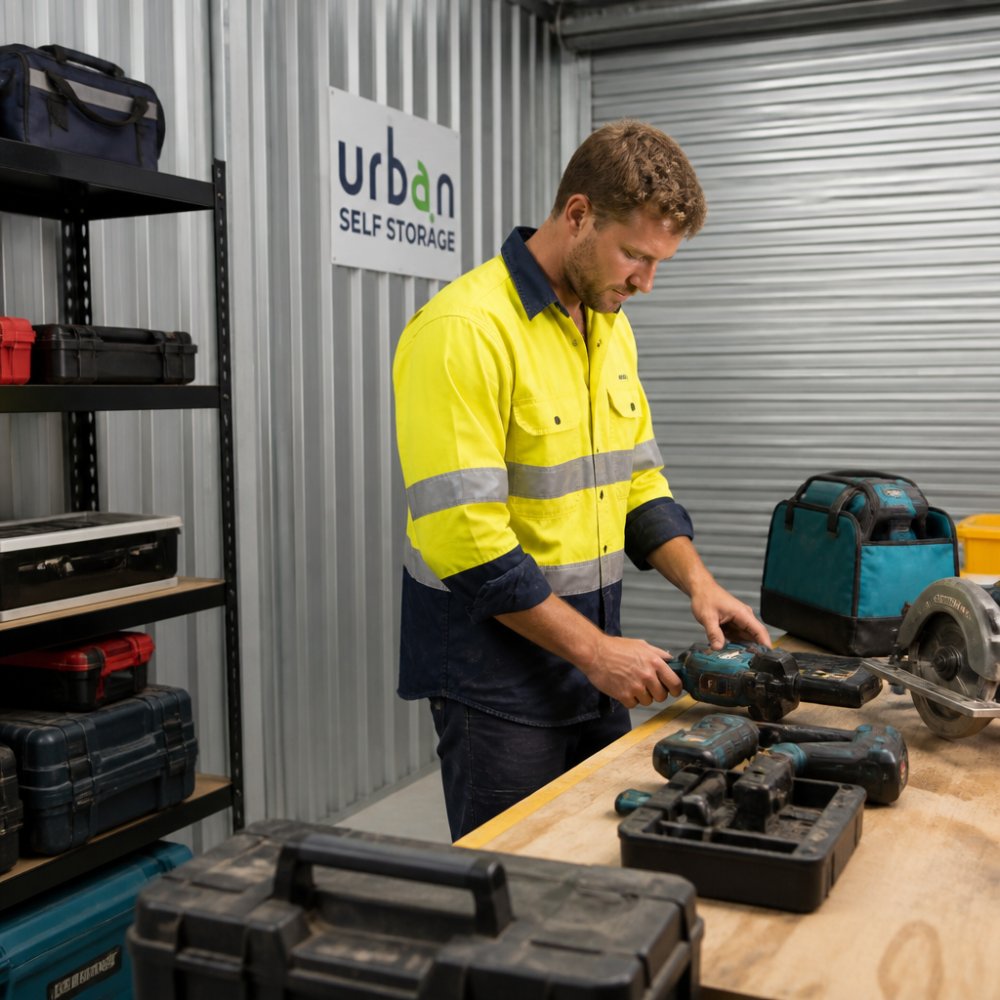
At Urban Self Storage, tradies and contractors can access their units during facility hours to load, unload and sort gear, and our drive-up units make that quick and practical. What we ask is that the unit stays a storage space, not a workshop floor. That keeps the facility compliant with fire safety regulations and keeps everyone’s insurance valid.
The reason is not bureaucratic fussiness. Fire safety regulations treat stored goods very differently from active work areas, and once you introduce power tools, flammable materials or heat sources, the risk profile of the whole building changes. Ventilation requirements, fire separation and extinguisher placement are all designed around storage, not around someone running a grinder at the back of a unit.
If you need genuine bench space, ask the facility before you sign whether they have any units approved for light activity, or whether they can point you to a nearby shared workshop. Getting a clear answer up front saves you from a breach notice later, and it is a question good facility managers hear often.
Business Storage for Tradies: Making It Work Compliantly
Business storage for tradies works well when you treat the unit as a secure depot, not a second workshop. The pattern that succeeds is simple: store everything at the facility, do the actual work on site at the job, and use the unit for pickups, drop-offs and stock rotation.
Book Online in 3 Minutes & Get 50% Off Instantly →
A few habits that keep tradies compliant and organised:
- Use shelving and labelled crates so you can find gear fast during a short access window.
- Keep the aisle clear for loading and unloading, especially in a drive-up unit.
- Store flammables properly, in sealed containers, and check what the facility classifies as prohibited items.
- Rotate stock so you are not digging through a pile of boxes every morning.
- Check your insurance for business contents covers goods held in storage, not just at your home or on site.
For a deeper look at how contractors organise a unit around a working week, our post on business storage tips for tradespeople and contractors walks through the setup in detail.
If you are running an e-commerce operation rather than a trade, the same logic applies. A unit works as an inventory workspace hybrid for picking and packing if your lease permits it, but check the commercial use terms first. Our business storage options are built around flexible access, so you can get in, grab what you need and get moving. If your stock or equipment outgrows a standard unit, our large storage units in Bunbury give you the extra floor space without changing how you work.
Insurance, Fire Safety and Lease Termination Risks
Insurance is where most storage-as-workshop plans quietly fall apart, and it is the angle competitors gloss over.
Three things to check before you commit:
| Risk | What triggers it | How to avoid it |
|---|---|---|
| Insurance claim denied | Undisclosed commercial activity | Disclose use, confirm liability cover |
| Fire code breach | Heat, sparks or fumes in unit | No welding, spraying or grinding |
| Lease termination | Breach of permitted use clause | Confirm allowed activities in writing |
| Council infringement | Unapproved business land use | Keep unit as storage only |
The safest way to use a storage unit for business is to store there and work elsewhere. Confirm your permitted use in writing, insure your business contents at the storage address, and keep the unit free of fire risk.
Frequently Asked Questions
Can I turn a storage unit into a workshop?
Most facilities let you store tools and equipment but restrict or prohibit working inside for extended periods. Running machinery, staying for hours, or using the unit as a registered workspace usually breaches fire safety regulations, insurance terms and zoning rules. Quick tasks like loading, unloading and light organising are typically fine. Check your tenancy agreement clauses and ask facility management directly before setting up a workbench setup.
Can you run power tools in a storage unit?
Generally no, not as standard use. Running power tools raises fire risk, noise restrictions issues and insurance concerns. Some facilities permit brief use during loading or unloading only. Always confirm with facility management first.
Can I use a storage unit as my registered business address?
In most cases, no. Storage facilities are not licensed as business addresses, and using one for business registration can breach your rental contract and local council regulations. Some providers allow mail and parcel delivery as an add-on service, but that is different from a registered address. If you need a compliant business address, use a virtual office or serviced address service instead.
What are the fire safety regulations for storage unit workshops?
Storage units fall under building codes and fire safety regulations that limit occupancy, flammable materials and machinery use. Running welders, grinders or other spark-producing tools inside a unit typically violates these rules. Hazardous materials like fuel, solvents and gas cylinders are usually prohibited items. Facilities also cap occupancy limits and restrict working hours to reduce risk. Compliance protects you, other tenants and your insurance coverage.