
Last Updated: November 6, 2026
Quick Summary
The cheapest way to store a boat in Bunbury is usually at home on a driveway or in a shed, with no monthly fee. If you need off-property storage, open-air bays and trailer-friendly units are typically the lowest-cost commercial options, while covered bays and marina pens cost more. Compare rates and confirm current prices with each boat storage Bunbury provider before you commit.
- Home driveway or shed storage has no monthly fee but may breach council or strata rules.
- Open-air bays are the cheapest commercial option but leave the boat exposed to sun and salt air.
- Measure the boat and trailer together, since combined length and height usually exceed the hull alone.
- Check whether an advertised rate includes insurance, access fees and admin charges before comparing.
- Winterise the boat, cover it with a breathable cover and confirm insurance before long-term storage.
Table of Contents
- The Cheapest Boat Storage Options in Bunbury at a Glance
- Comparing Boat Storage Options by Cost, Access and Security
- Boat Storage Monthly Rates: What Affects the Price
- Boat and Trailer Storage Space: Choosing the Right Size
- Boat Pens vs Dry Storage in Bunbury
- Winterising a Boat Before Long-Term Storage
- Booking Secure Boat Storage with Urban Self Storage
- Frequently Asked Questions
The Cheapest Boat Storage Options in Bunbury at a Glance
The cheapest way to store a boat in Bunbury is usually at home on a driveway or in a shed, with no monthly fee, though many owners still look at commercial options for secure boat storage Bunbury. If you need off-property storage, open-air bays and trailer-friendly units are typically the lowest-cost commercial options, while covered bays and marina pens cost more. Urban Self Storage operates two Bunbury-area locations in East Bunbury and Picton, so you can compare options directly before committing. If you need a secure, ready-to-use space, our Bunbury’s boat storage facility is one option to compare against open-air bays.
Costs vary with boat size, storage duration, access needs and security, so confirm current rates with each provider.
Comparing Boat Storage Options by Cost, Access and Security
Each option trades cost against convenience and protection. The table below summarises the main choices for boat owners in the Bunbury area.
| Option | Indicative Cost | Pros | Cons |
|---|---|---|---|
| Home driveway or shed | No monthly fee | Lowest cost, immediate access, easy maintenance | Needs suitable space, may breach council or strata rules, limited security |
| Open-air bay | Low, confirm current rates | Cheapest commercial option, flexible terms | Exposed to sun, salt air and weather, less protection |
| Covered bay | Mid-range, confirm current rates | Shelter from weather and UV, less wear on the hull | Higher cost than open-air, bay availability can be limited |
| Secure unit or bay (CCTV, 24/7 access) | Mid-to-higher, confirm current rates | Strong security, frequent access, suits trailer boats | Costs more than basic open-air storage |
| Marina or harbour pen (e.g. Casuarina Boat Harbour) | Typically higher, contact the facility for current pen fees | Boat stays in the water, no towing or launching | Higher maintenance, higher costs than dry storage |
Watch out: Check whether a provider’s advertised rate includes insurance, access fees and admin charges before comparing it with another provider’s price.
Boat Storage Monthly Rates: What Affects the Price
Monthly rates depend on several factors, and two listings for similar-sounding storage can differ considerably. The main drivers are:
- Boat and trailer size: Longer and taller combinations need larger bays, which cost more.
- Covered or open-air: Shelter from the elements usually adds to the monthly fee.
- Access hours: Round-the-clock access typically costs more than business-hours access.
- Security features: CCTV, gated access and on-site monitoring add to the price.
- Contract length: Month-to-month terms give flexibility, while longer commitments can reduce the monthly rate.
Covered vs Uncovered Boat Storage
Covered storage protects your boat from sun, rain and salt air. This reduces fading, cracking and hull wear over time. Uncovered storage is cheaper, but it suits boats that are used regularly or owners willing to cover the vessel themselves. In a coastal location like Bunbury, the salt air makes protection more valuable, so weigh the extra cost against the likely damage to a boat left exposed for months. You can read more in how to protect caravans and boats in local storage.
Boat and Trailer Storage Space: Choosing the Right Size
Measure the boat and trailer as one unit before you enquire about any boat storage Bunbury bay or unit. The combined length is almost always longer than the boat alone because the trailer frame, tow coupling and outboard add to the footprint. Most trailer boats in the 4 metre to 6 metre-plus range need a bay that fits the full rig, plus clearance to open the roller door and walk around the hull. If you are unsure which unit fits your rig, our large storage units in Bunbury are worth comparing against your measurements.
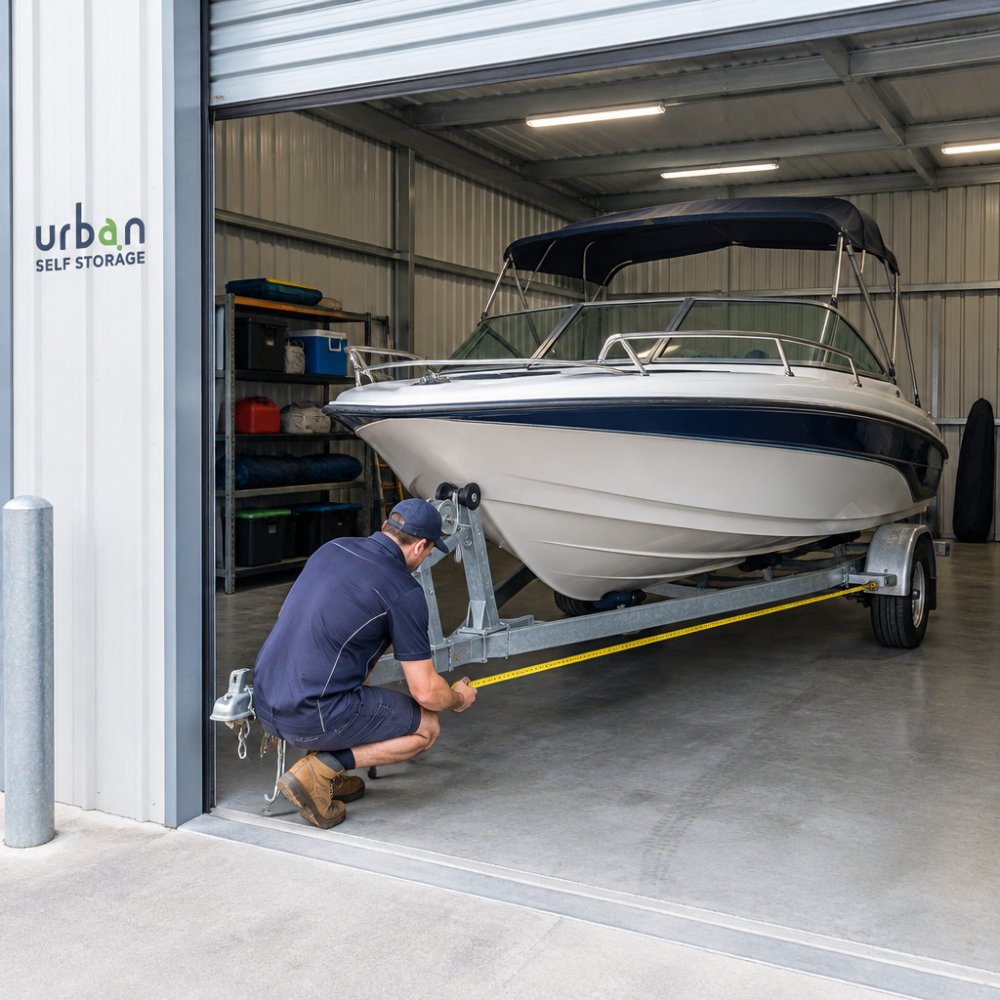
Use the guide below as a starting point, then confirm exact internal dimensions with the provider. Bay sizes vary between facilities, and a bay advertised for a 5 metre boat may not fit a 5 metre boat on a braked trailer with a folding drawbar extended.
| Boat and trailer length | Typical space to ask for | What to check |
|---|---|---|
| Up to 4 m | Small bay or driveway unit | Drawbar and outboard clearance, door width |
| 4 m to 5 m | Standard trailer bay | Combined length with trailer, height with bimini folded |
| 5 m to 6 m | Large bay or double-width unit | Turning room, tow vehicle access, roller door height |
| 6 m+ | Oversized bay or hardstand | Height clearance for T-tops and antennas, manoeuvring space |
Height clearance matters as much as length. A bimini top, rocket launcher, outboard motor or tall tow bar can push a rig past a standard roller door. Measure the highest point with the boat on the trailer and the tow vehicle disconnected, then add a margin for suspension movement.
Width and turning clearance are the other common traps. A bay that fits the boat may still be too tight to reverse into with a long-wheelbase vehicle. Ask whether the site has drive-through access or a manoeuvring area, and check whether the bay is a driveway unit with a door or an open-air bay you reverse into.
Watch out: Quoting the boat’s hull length rather than the combined boat-and-trailer length is the most common reason a booked bay turns out to be too small on arrival.
Boat Pens vs Dry Storage in Bunbury
Boat pens keep your vessel in the water, which removes the need to tow and launch. Casuarina Boat Harbour is the main local pen and hardstand precinct, with pens, a slipway and a two-lane ramp. A pen suits owners who use the boat often and want to step aboard without hitching up, but pens carry higher maintenance demands, including regular antifouling, anode checks and corrosion inspection, and they generally cost more than dry storage.
Dry storage, whether a trailer bay, a secure gated unit or a home shed, is usually cheaper and keeps the hull out of the water. The trade-off is that you must tow and launch each time you use the boat. For occasional users and off-season storage, that trade-off is often worth it.
Ramp proximity changes the maths. Storage near the boat ramp reduces towing distance and launch time, which matters if you fish or boat weekly. Storage closer to the harbour and ramp can cut towing time, so weigh the monthly rate against fuel, towing time and launch queueing.
Harbour hardstand is a third option that sits between a pen and a commercial bay. It is useful for maintenance, antifouling and short-term work, but availability and terms are set by the harbour operator, so confirm current access and conditions directly rather than assuming a hardstand spot is available.
Watch out: A pen fee quoted by a facility may not include insurance, access charges or maintenance requirements, so compare the total cost against a dry bay before deciding.
Winterising a Boat Before Long-Term Storage
Preparing your boat before a long storage period prevents problems when you return to it. Work through the following steps:
- Wash the hull and remove salt residue, marine growth and debris.
- Drain the engine cooling system and fuel lines, or add fuel stabiliser to a full tank.
- Change the engine oil and replace the oil filter.
- Remove the battery, store it on a trickle charger, and keep it off the concrete floor.
- Clean and dry the interior to prevent mould, and leave cabin hatches slightly open for ventilation.
- Cover the boat with a breathable cover, not plastic, which traps moisture.
- Remove valuables and note the storage location and contact details for the provider.
- Check your insurance policy covers the boat while it is in storage.
Booking Secure Boat Storage with Urban Self Storage
Urban Self Storage offers boat storage at its East Bunbury and Picton locations, with flexible short-term and long-term options and 24/7 CCTV surveillance. Storage options include boat, caravan, jet ski and large storage units. Our boat storage facility in Bunbury suits trailer boats, and you can find the right storage unit size for your boat and trailer before you book. If you are weighing up contract options, read our guide on short and long term storage in Bunbury WA before committing.
Visit our website to view current pricing and check availability at either location.
Frequently Asked Questions
How much does boat storage cost in Bunbury?
Boat storage costs in Bunbury vary with the type of space, the size of the boat and trailer, and the length of the rental. Open-air bays are usually the lowest-priced option, while covered bays and enclosed units cost more. Confirm the current monthly rate, any setup or admin fees, and access charges before you commit. Urban Self Storage lists its pricing on its website, and you can also request a quote for your specific boat size.
What is the cheapest way to store a boat?
Storing a boat on private property, such as in a driveway or a shed, is usually the lowest-cost option because there is no monthly rental fee. It only works if you have enough space, can keep the boat secure, and your local council or strata rules allow it. For a boat you cannot keep at home, an open-air bay in a secured facility is generally the cheapest rented option. Compare the total monthly cost against access hours and security features, since a slightly higher rate can be better value if it includes CCTV and 24/7 access.
Is covered boat storage worth it in WA?
Covered storage costs more than open-air storage, but it offers protection from sun, rain and salt-laden air, which can cause fading, cracking and corrosion over time. It is most worth considering for boats kept stored for several months, for boats with canvas or soft covers, or for owners who want a cleaner, drier space. For a short-term or occasional use boat, open-air storage with a good quality cover can be a sensible budget choice. Weigh the extra monthly cost against the condition and resale value you want to protect.
Can I store my boat at home in Bunbury?
Many Bunbury owners keep a boat at home in a driveway, side yard or shed, which avoids monthly fees. Before doing so, check your local council rules and any strata or body corporate restrictions on parking or storing vehicles and trailers. You will also need enough clearance for the boat and trailer, secure side access, and a plan for keeping the vessel protected from weather. Home storage suits owners who use the boat frequently, but it may not be practical for larger vessels or for storing a boat over a long period.
