
Last Updated: October 25, 2026
Quick Summary
Yes, CCTV footage can strengthen your storage insurance claim by documenting a break-in, theft or damage, but it’s supporting evidence only, not automatic proof of loss. A storage insurance claim also requires a police report, inventory list, receipts, serial numbers and proof of ownership to succeed.
- Request CCTV footage within 24 hours of discovering a break-in, as most facilities retain recordings for only 30 to 90 days before they’re overwritten.
- Contact facility management immediately, file a police report and notify your insurer within the deadline stated in your policy to preserve your claim.
- Photograph all damage, create a detailed inventory with serial numbers and receipts, and keep the original CCTV file untouched as evidence.
- Facilities may lawfully redact footage showing other tenants or common areas under the Privacy Act 1988 (Cth) and state surveillance laws.
- A loss adjuster assesses your claim against common exclusions: no forced entry, unlocked unit, undeclared valuables, wear and tear, and mould or damp damage.
Table of Contents
- Can CCTV Footage Be Used for a Storage Insurance Claim?
- What to Do After a Storage Unit Break-In
- How to Request CCTV Footage from a Storage Facility
- Storage Facility CCTV Retention Period: What You Need to Know
- Storage Unit Theft Insurance Claim Evidence Checklist
- Common Insurance Exclusions and Liability Limits
- Protecting Your Storage Unit and Strengthening Your Claim
- Frequently Asked Questions
Can CCTV Footage Be Used for a Storage Insurance Claim?
Yes, CCTV footage can strengthen your storage insurance claim, but it’s not automatic proof of loss.
Footage helps, but it doesn’t replace proof of ownership and loss, you still need to prove what was inside your unit and its value.
At Urban Self Storage, our facilities use advanced 24/7 CCTV surveillance across all units. But having cameras isn’t enough, you need to know how to use that footage to support your claim.
What to Do After a Storage Unit Break-In
The first 24 hours matter. Your actions now determine whether your claim has a real chance of success.
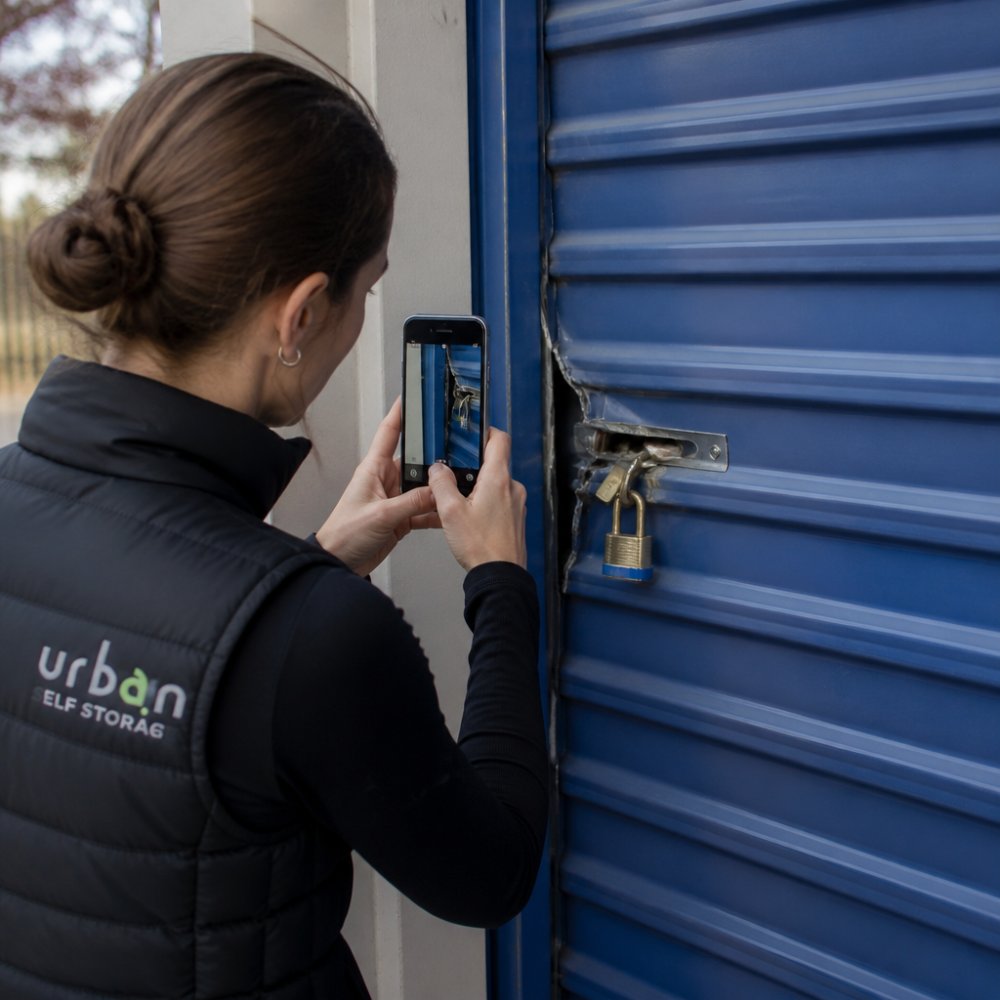
Step 1: Stop and document immediately. Do not touch anything inside the unit.
Step 2: Contact facility management right away. Tell them about the break-in and ask them to preserve the CCTV footage, giving the date and approximate time.
Step 4: Notify your insurance company. Contact them within the timeframe stated in your policy, many insurers have strict deadlines.
How to Request CCTV Footage from a Storage Facility
The facility operator holds the footage, not you. A CCTV footage request needs to be specific, in writing and made fast, the footage retention period ticks from the incident, not from when you notice it.
Who to contact and what to say
Start with the facility manager or the administrative office, then follow up in writing so there is a dated record. A short, factual request works best. Here is a template you can adapt:
:::tip CCTV footage request template
Subject: Urgent CCTV footage request, unit [number], incident [date]
Dear [Facility Manager],
I am the tenant of unit [number]. On [date] I discovered [forced entry / theft / damage] at my unit, which I reported to police under event number [number].
I request preservation and release of CCTV footage covering:
- Camera(s) covering my unit door and the access corridor
- The entry gate and vehicle access point
- The period from [date/time] to [date/time] (please include at least 30 minutes either side of the suspected incident)
Please confirm the footage retention period and whether you will release the file directly to me, to my insurer, or to police. I am happy to provide identification and cover any reasonable retrieval cost.
Kind regards,
[Name] | [Phone] | [Email]
The two common pathways
Many facilities release footage directly to you on a formal written request with identification. Others require the request to be routed via police or your insurer, common where the recording captures other tenants or common areas. If refused, ask in writing for it to go to your insurer or police instead; this is standard procedure and does not weaken your claim.
Privacy limits on release
A facility may lawfully restrict or redact footage showing other people or other customers’ belongings. The Privacy Act 1988 (Cth) and state surveillance laws govern how recordings are handled, and the facility owes a duty of care to all tenants. You may receive a redacted clip focused on your unit and entry point, that’s normal, not a refusal.
Chain of custody: protect the evidence
If you do receive a file, treat it as evidence from the first moment:
- Keep the original untouched, do not trim, filter, compress or re-encode it.
- Save a working copy and keep the original in a separate folder with the date received.
- Record who sent it, when, and from which camera and time range.
A verifiable original reduces disputes about authenticity and makes the loss adjuster’s job easier.
If footage is unavailable or incomplete
Recordings get overwritten, cameras have blind spots and systems go down. If the footage is gone, ask the facility for a written statement setting out their footage retention period and why it’s unavailable, and keep it in your claim file.
Book Online in 3 Minutes & Get 50% Off Instantly →
Storage Facility CCTV Retention Period: What You Need to Know
Retention periods vary widely, there’s no single legal requirement across all facilities, which is why acting fast is critical. Most facilities keep CCTV footage for 30 to 90 days (illustrative; some longer, some shorter), depending on storage capacity, policy and camera numbers.
Why this matters: Wait two months to report a break-in and the footage may already be gone, cameras record continuously and older footage is automatically deleted. Ask about the retention period when you rent, get it in writing if possible, and request footage immediately after a break-in rather than waiting to see if your claim is approved. Once overwritten, it’s gone for ever.
Access logs: Some facilities maintain access logs showing when your unit was opened and who accessed it, corroborating when the break-in likely occurred. Request these alongside the CCTV footage.
Storage Unit Theft Insurance Claim Evidence Checklist
Your insurer will assess your claim based on the evidence you provide. Here’s what they typically need:
| Evidence Type | What to Include | Why It Matters |
|---|---|---|
| Police report | Event number and incident details | Proves the theft was reported to authorities |
| CCTV footage | Video showing forced entry or theft | Documents the incident visually |
| Inventory list | Item descriptions, values, serial numbers | Proves what was lost |
| Receipts and photos | Original purchase proof and images | Establishes ownership and value |
| Facility documentation | Lease agreement and access records | Shows you had lawful possession |
| Damage photos | Images of locks, doors, frames | Proves forced entry occurred |
| Correspondence | Emails to facility and police | Creates a timeline of your actions |
Missing evidence weakens your claim, a strong claim includes at least five of these seven categories.
Serial numbers and proof of ownership: For electronics, tools and equipment, serial numbers prove you owned the specific item and let the insurer verify its value.
Timestamps matter: Ensure your photos and videos are timestamped (most phones do this automatically) to prove when you discovered the damage.
Common Insurance Exclusions and Liability Limits
Your goods insurance policy will have exclusions, and a loss adjuster will test your claim against them. Knowing them before you lodge prevents an avoidable denial.
Exclusions that most often sink storage claims
- No evidence of forced entry. Without visible signs of breaking and entering, the insurer may argue the unit was left unlocked or accessed with a key. This is where CCTV footage earns its keep: a clip showing a cut padlock, a pried door frame or an unauthorised person directly counters the exclusion. Photograph the lock and frame before anything is moved.
- Unlocked or unsecured unit. Some tenant insurance excludes claims where the unit wasn’t properly locked; footage and damage photos showing a forced lock rebut this.
- Undeclared valuables. Jewellery, collectibles, tools and high-value electronics often sit outside standard cover limits unless declared. Declare them at the start, a later claim for an undeclared item is commonly reduced or refused.
How a loss adjuster assesses the claim
The loss adjuster works from your evidence package: the police report event number, your incident report to the facility, damage photographs, your inventory list with receipts and serial numbers, access logs and any CCTV footage. They look for consistency, does the footage timestamp match the access log and your statement? A complete, internally consistent file is the single biggest factor in a smooth outcome.
Policy excess and insurer deadlines
Your policy will carry an excess, deducted from any payout. Check your policy documents for the figure and cover limit. Insurers also set deadlines for notifying a claim, often days from discovery, so notify promptly even while evidence is being assembled. Late notification is a common, avoidable reason for dispute.
Facility liability clauses versus tenant insurance
Storage facility contracts typically include liability clauses limiting the operator’s responsibility for loss or damage to goods. The facility isn’t never liable, negligent security may open a separate avenue, but most claims are properly made through your own goods insurance or tenant insurance first. Read the liability clause so you understand where the facility’s duty of care ends and your cover begins, and don’t assume the facility’s insurance covers your belongings; in most cases it does not.
Footage supports your claim but does not replace proof of ownership. Even a clear break-in clip will not carry a claim for items you cannot describe, value or show you owned.
Protecting Your Storage Unit and Strengthening Your Claim
Prevention is better than a claim. Smart security habits reduce your risk and make claims easier to prove.
Before you store anything:
- Photograph your items and keep receipts safely at home, not in the unit.
- Declare high-value items to your insurer and ask what cover limits apply.
- Choose a facility with strong security.
While your items are stored:
- Visit regularly, frequent access deters thieves and helps you spot problems early.
- Keep the unit locked with a quality padlock.
- Maintain an updated inventory so missing items are noticed immediately.
If a break-in occurs:
- Act within 24 hours, contact the facility, police and your insurer.
- Request footage immediately.
- Gather all evidence, photos, receipts, serial numbers and police reports strengthen your case.
- Learn the legal framework governing when facilities must release footage and your rights as a tenant.
Urban Self Storage’s advanced 24/7 CCTV surveillance is designed to deter theft and support claims when incidents do occur. Our secure facilities and quick access process help you protect your belongings from the start. If the worst happens, you’ll have documentation and support to make your claim process smoother. Get started with Urban Self Storage and store with confidence.
Frequently Asked Questions
How long do storage facilities keep CCTV footage?
Retention periods vary by facility, typically ranging from 30 to 90 days. Urban Self Storage maintains footage to support security and incident investigation. Always ask your facility about their specific retention window when you sign the lease, and request footage immediately if an incident occurs, waiting beyond the retention period means footage may be overwritten and unavailable for your storage insurance claim.
Will my insurance cover theft from a storage unit?
Most contents insurance policies cover theft from storage units, but common exclusions apply: forced entry not reported to police, unlocked units, undeclared high-value items, and items stored against policy conditions. Check your policy wording for exclusions and excess amounts. Tenant insurance typically excludes storage, so verify your cover before storing valuables and notify your insurer of the storage location.
What evidence do I need to claim for stolen items from storage?
Insurers require proof of ownership (receipts, photos, serial numbers), a police report with event number, incident report from the facility, CCTV footage showing forced entry or the incident, photographs of damage to locks or the unit, and an inventory list of stolen items with estimated values. CCTV footage alone does not prove loss, you must document what was taken and its value through receipts or other proof.
Can a storage facility refuse to give me CCTV footage?
Facilities may restrict footage release to protect other tenants’ privacy and comply with the Privacy Act 1988. Requests are often routed through police (who can obtain it as evidence) or your insurer (who may request it directly). If the facility refuses without valid reason, escalate to the loss adjuster or your insurance company, who have stronger legal standing to access footage relevant to your claim.
A storage break-in is stressful, but you’re not helpless. CCTV footage, police reports, and clear evidence of what you owned and lost give your insurer what they need to assess your claim fairly. The key is acting fast, within hours, not days. Request footage before it’s overwritten. File your police report. Gather your proof of ownership. These steps, combined with your facility’s surveillance records, give your claim the best chance of success.
