What Makes Large Storage Units Right for Your Needs
Large storage units serve a specific purpose that standard-sized facilities can’t match. Whether you’re storing a caravan, managing business inventory, or consolidating household goods during renovation, understanding what qualifies as “large” and why it matters is essential.
A large storage unit typically ranges from 50 to 95+ square metres, offering enough space for multiple vehicles, substantial furniture collections, or significant commercial stock. Large units operate differently than smaller alternatives, requiring different access methods, security considerations, and pricing structures.
At Urban Self Storage, we’ve observed that customers often misjudge space requirements before committing. They either overestimate (paying for unused capacity) or underestimate (discovering mid-move that their caravan won’t fit). Choosing the right size saves money, reduces access friction, and eliminates frustration. This guide helps you identify your actual needs, understand security features you should expect, and compare cost structures so you can make an informed decision about large storage units in Bunbury.
Large Storage Unit Sizes Guide: Finding the Right Fit
Large storage units fall into two categories: medium-large (around 50-65 square metres) and extra-large (75-95 square metres). Understanding these dimensions and how they translate to real-world capacity is essential before committing.
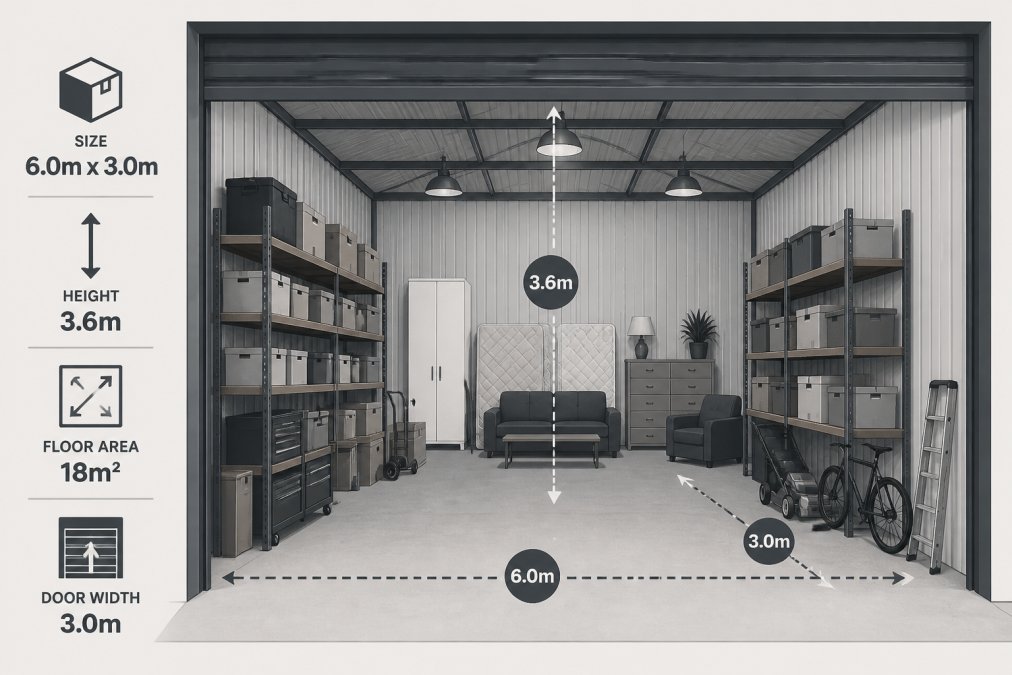
Interior view of a spacious large storage unit with high ceilings, showing furniture stacked neatly against walls, boxes organised on metal shelving units, and clear pathways for vehicle or equipment access
Measuring Your Space Requirements
The most common mistake is eyeballing dimensions without measuring. A 9-metre by 3-metre unit feels deceptively spacious when empty, but fills quickly once you load furniture, boxes, and equipment.
Start by listing what you’re storing specifically: not just “furniture,” but “three-seater sofa, dining table with six chairs, queen bed frame, two wardrobes, and fifteen moving boxes.” Measure each item’s footprint, length, width, and height. Account for stacking and add 20 per cent buffer space for access and air circulation, which protects belongings from moisture and allows retrieval without dismantling the entire unit.
For vehicles, the calculation is straightforward. A standard caravan is typically 6-8 metres long and 2.4 metres wide.
A large storage unit with high roller doors (minimum 2.4 metres clearance) and adequate length is essential. Urban Self Storage’s Bunbury locations offer units specifically designed for vehicle storage with drive-up access that eliminates cramped manoeuvring.
Visit the facility before booking. Walk through an empty unit of the size you’re considering, bring your measurements, and visualise your items in the space. This 15-minute step eliminates guesswork.
Common Uses for Large Units
Household storage during renovation or relocation is the most common use. Families typically store furniture, boxes, and appliances while homes are renovated or during moves. These customers often need 3-6 months of storage and prioritise easy access for retrieving specific items weekly or fortnightly.
A 50-65 square metre unit usually suffices unless storing a five-bedroom home’s contents.
Business inventory and equipment storage requires different considerations. Retailers, tradies, and e-commerce operators need frequent stock rotation, predictable access, and critical organisation. Climate control becomes important for electronics, textiles, or temperature-sensitive goods. Urban Self Storage’s flexible lease options suit this use case, allowing businesses to expand or downsize without penalty.
Recreational vehicle storage for caravans, boats, and jet skis demands high roller doors, secure gating, and weather protection. These expensive items require protection from UV damage, salt spray, and theft. Large units with drive-up access and 24/7 CCTV surveillance are essential.
Equipment and tool storage for contractors requires accessible units where tools remain available throughout the working week, security is absolute (tools are theft targets), and organisation prevents damage. A 50-75 square metre unit typically works, though layout matters more than raw size.
Storage Unit Security Features Australia: What to Expect
Security is the primary reason people choose professional storage facilities. Understanding what constitutes genuine security versus marketing language helps you evaluate facilities honestly.
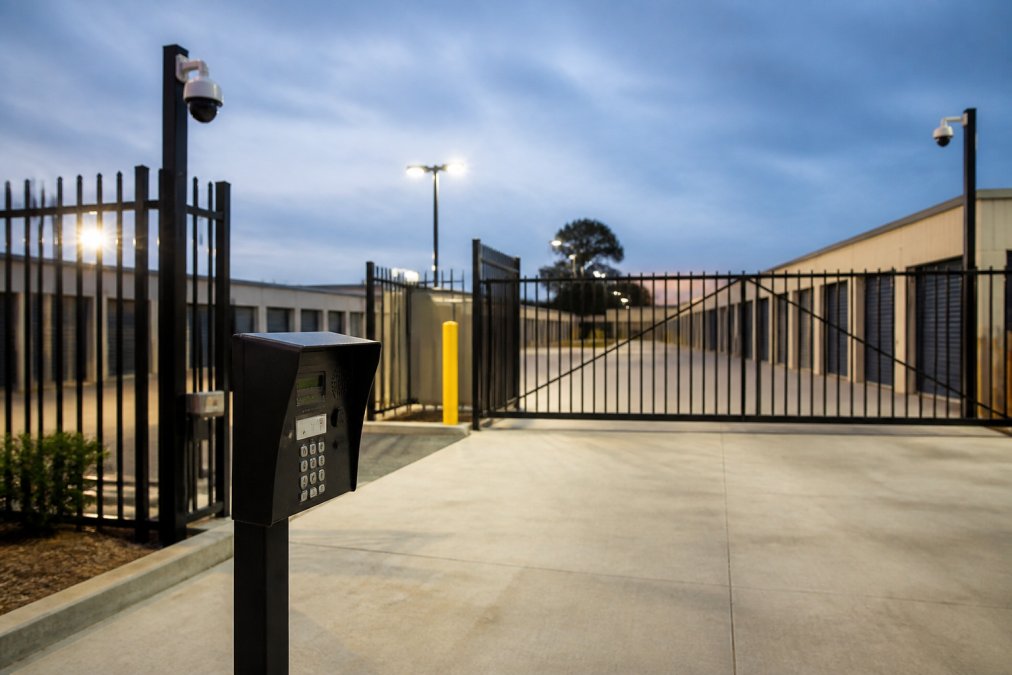
Modern secure storage facility entrance with electronic gate and PIN keypad, CCTV cameras mounted on corner posts, gated perimeter fence, and well-lit access area at dusk
Australian storage facilities typically offer perimeter fencing, gate access controlled by PIN or key card, and CCTV surveillance. Urban Self Storage provides 24/7 CCTV monitoring, electronic gate access with unique PIN codes per customer, and on-site management presence. A facility with cameras but no active monitoring is primarily a deterrent; monitored surveillance actually responds to incidents.
Gated access with individual PIN codes prevents unauthorised entry and logs every access event with timestamp and customer ID, creating an audit trail. Avoid facilities still using padlocks and keys, as a single lost key undermines security for everyone.
CCTV coverage should extend to all access points, main aisles, and unit entrances. Ask directly what areas are monitored and how footage is retained. A facility that can’t answer this is being evasive.
Climate control and pest control protect belongings from damage. Temperature and humidity fluctuations degrade electronics, warp wooden furniture, and encourage mould. Pest control prevents rodent damage.
These are practical protection, especially for long-term storage.
Insurance is your final security layer. Australian storage facilities typically don’t insure belongings; that’s your responsibility. Confirm your home or contents insurance covers items in external storage before signing a lease. If yours doesn’t, ask whether the facility offers optional coverage.
Business Storage Solutions Bunbury: Flexible Space for Growth
Small to medium-sized businesses often need more space than a garage but can’t justify commercial warehouse leasing costs. Large storage units bridge this gap, offering flexible, cost-effective alternatives.
Business storage differs from household storage in three ways: access frequency is higher (often daily or multiple times weekly), inventory rotation is constant, and organisation is critical for locating items quickly.
A poorly organised unit becomes a liability, causing lost stock tracking, wasted time, and damage risk.
Urban Self Storage’s flexible lease terms suit business needs perfectly. Unlike traditional commercial leases locking you into 12 or 24-month commitments, Urban offers short-term options allowing you to scale as demand fluctuates. This is valuable for seasonal businesses or e-commerce retailers managing inventory surges.
Access hours matter for business users. A facility closing at 6 pm is useless if you need stock for weekend markets or evening events. Urban’s Bunbury locations offer extended access, and electronic PIN-code systems mean you’re not dependent on staff availability.
Organisation systems within the unit multiply effective storage capacity. Shelving, racking, and clear labelling enable vertical stacking and quick location. Plan internal organisation before moving in; a well-organised unit from day one stays productive.
For most small businesses, large storage units are 30-50 per cent cheaper than equivalent warehouse leasing.
Short-Term vs Long-Term Storage Costs: Which Suits You
Storage pricing varies based on unit size, lease length, and facility location. Understanding how these factors interact helps you avoid overpaying.
Short-term storage (typically three to six months) usually attracts higher per-month rates than long-term leases. Facilities offer discounts for commitment, but short-term rentals provide flexibility without contracts extending beyond actual need.
Long-term storage (12 months or longer) reduces monthly costs significantly. The trade-off is reduced flexibility; early exit may incur penalties.
Before committing, confirm cancellation terms. A facility charging six months’ rent as an early-exit penalty asks you to absorb substantial risk.
Urban Self Storage provides up to 50 per cent off the first month for online bookings, meaningfully reducing initial outlay. Confirm additional costs upfront: insurance, optional climate control, and access fees. A facility burying surprise charges in fine print prioritises short-term revenue over customer trust.
The break-even calculation is straightforward. If short-term rates are $350 per month and long-term rates are $280 per month, long-term becomes cheaper after 4.67 months. For six-month needs, long-term is cheaper; for three months, short-term is.
Access frequency matters more than monthly rate. A facility 45 minutes away becomes expensive in terms of your time. Urban’s Bunbury locations are centrally positioned, reducing travel time and making frequent access practical.
Why Urban Self Storage Stands Out in Bunbury
Urban Self Storage operates two Bunbury area locations, East Bunbury and Picton, specifically designed for local community storage needs. Local management understands Bunbury’s specific challenges: seasonal tourism influx, agricultural and trade activity, renovation cycles, and relocation patterns. This knowledge translates to practical advice.
Facility design reflects local needs. Both locations offer drive-up access essential for vehicle and large equipment storage. High roller doors (minimum 2.4 metres) accommodate caravans and boats without awkward manoeuvring. Wide aisles reduce frustration accessing units in the middle of facilities.
24/7 CCTV surveillance with electronic PIN-code access provides genuine security. Every access is logged, creating accountability and audit trails.
The move-in process is efficient. Most customers complete viewing, paperwork, PIN code receipt, and move-in in less than 10 minutes. This matters when managing renovation timelines or business inventory surges.
Flexible lease terms mean you’re not forced into 12-month commitments if your actual need is shorter. Urban offers short-term options without penalty, invaluable for temporary storage or seasonal inventory management.
Competitive pricing with promotional discounts (up to 50 per cent off the first month for online bookings) makes large units accessible. Cost-per-square-metre calculations often reveal Urban’s large units are cheaper than equivalent space elsewhere, particularly factoring in location and access convenience.
Customer feedback consistently highlights cleanliness and modern condition. Older facilities often feel cramped and poorly maintained; Urban’s locations are clean, well-lit, and professionally managed.
Choosing the right large storage unit in Bunbury requires balancing size, security, access, and cost. Urban Self Storage’s two Bunbury area locations offer spacious units with drive-up access, genuine 24/7 CCTV security, flexible lease terms, and competitive pricing. With advanced surveillance, a simple move-in process completed in less than 10 minutes, and on-site management support, Urban eliminates the uncertainty that makes storage decisions stressful. Book online now and receive up to 50 per cent off your first month’s rental.
Frequently Asked Questions
What size large storage unit do I need for a 3-bedroom house move?
For a typical 3-bedroom house, you’ll generally need a unit between 50-75 square metres. This accommodates bedroom furniture, lounge suites, kitchen items, and boxes. Measure your largest furniture pieces and list what you’re storing to calculate accurately. Urban Self Storage in Bunbury offers multiple large unit sizes; their team can help you choose the right fit based on your specific belongings.
How do large storage units in Bunbury compare in security features?
Most quality facilities in Bunbury offer 24/7 CCTV surveillance, electronic gate access with PIN codes, and secure fencing. Urban Self Storage includes advanced 24/7 CCTV monitoring and gated access, giving you confidence your belongings are protected. Always ask to see security infrastructure before committing, and confirm that surveillance is actively monitored, not just recorded.
Is short-term or long-term storage cheaper for business inventory in Bunbury?
Long-term storage typically offers better value per month, facilities often provide discounts for commitments of 6 months or more. Short-term storage costs more per month but suits temporary needs like renovations or seasonal overflow. Urban Self Storage offers flexible terms from weeks to years, and their online booking system shows transparent pricing so you can compare both options before deciding.
Can I access my large storage unit 24/7 in Bunbury?
Most Bunbury facilities offer 24/7 access via electronic PIN-coded gates, though some have restricted hours. Urban Self Storage provides 24/7 access at their Bunbury locations, ideal for businesses needing after-hours access or tradespeople collecting tools before early jobs. Confirm access hours match your schedule when choosing a facility.