

Table of Contents
- Why E-Commerce Retailers Turn to Self Storage for Inventory
- Benefits of Off-Site Storage for E-Commerce Businesses
- Cost-Effective Warehousing for Small Business Operations
- How to Organise a Storage Unit for Business Stock
- Scaling from Home Storage to Commercial Self Storage
- Security and Insurance Considerations for Business Stock
- Conclusion
Last Updated: August 26, 2026
Why E-Commerce Retailers Turn to Self Storage for Inventory
E-commerce retailers face a constant challenge: how to manage growing inventory without the overhead of traditional warehousing. How E-Commerce Stores Use Self Storage for Inventory has become a practical solution for businesses scaling beyond their home operations. The shift from a spare bedroom or garage to dedicated commercial space represents a critical turning point for online sellers.
The problem isn’t just about space. It’s about operational efficiency. When inventory lives across multiple locations, your home, a mate’s garage, a spare office, picking and packing orders becomes chaotic. Shipping times slow down. Stock rotation becomes guesswork. Customers wait longer for their orders, and your reputation takes a hit.
Self storage offers a middle ground between bootstrapping from home and committing to a full warehouse lease. You get dedicated, secure space without the long-term financial commitment. You can scale up or down based on seasonal demand. You control access 24/7, which matters when you’re fulfilling orders at odd hours or need to restock quickly.
For many e-commerce operators, self storage solves the scalability problem at the exact moment when it matters most, when home-based storage no longer cuts it, but a traditional warehouse feels overpriced and inflexible.
Benefits of Off-Site Storage for E-Commerce Businesses
Moving inventory off-site delivers tangible operational benefits that directly impact your bottom line. Off-site storage for e-commerce separates your living space from your business operations, which improves both your quality of life and your ability to scale efficiently.
The first benefit is operational focus. When your bedroom isn’t doubling as a stockroom, you can actually sleep without tripping over boxes. Your family doesn’t have to navigate around pallets. This separation creates a professional boundary between home and business, something that becomes critical as you grow.
The second is inventory visibility. A dedicated storage unit forces you to implement proper stock management. You label shelves, track quantities, and know exactly what you have and where it is. This reduces dead stock, improves stock rotation, and prevents overselling. Many e-commerce operators report that moving to self storage actually revealed how much excess inventory they’d been carrying without realising it.
The third is fulfillment speed. When everything is in one place, organised by product type, picking orders becomes faster. You’re not hunting through multiple locations for items. Your team can process more orders in less time. This translates directly to faster shipping times and happier customers.
Security is the fourth benefit. Self storage facilities offer 24/7 CCTV surveillance, controlled access, and climate management. Your inventory is protected from theft, weather damage, and pests, risks that home storage can’t adequately address. For businesses storing higher-value products, this peace of mind alone justifies the cost.
The fifth benefit is flexibility. You’re not locked into a five-year warehouse lease. Most self storage agreements are month-to-month or short-term, allowing you to scale storage space up or down as demand fluctuates. During peak season, you rent extra capacity. During slow months, you downsize. This agility is impossible with traditional commercial leases.
Cost-Effective Warehousing for Small Business Operations
Traditional commercial warehousing is built for larger operations. Minimum lease terms are typically 12 months or longer, with fixed costs that don’t adjust to your actual inventory levels. You’re paying for space you might not fully use, especially in your first year.
Self storage flips this model. Cost-effective warehousing for small business operations means you pay for only the space you need, for only as long as you need it. There’s no long-term lease trap. No surprise utility bills. No complex commercial real estate negotiations.
The pricing structure is straightforward. You select a unit size based on your inventory volume, pay a monthly rental fee, and that’s your primary cost. Some facilities offer short-term discounts or promotional rates, which can further reduce your initial outlay. For a business with fluctuating inventory, common in e-commerce, this flexibility is worth significantly more than a slightly cheaper per-square-metre rate locked into a rigid lease.
Compare this to commercial warehousing: you’d be paying for climate control, 24/7 staff, forklift access, and other amenities you might not need. Self storage strips away those extras and lets you keep costs lean.
There are secondary costs to factor in. You’ll need shelving or racking systems to maximise your unit space. You might hire someone to manage inventory during peak seasons. These are variable costs you control, not fixed overhead imposed by a landlord.
The real cost advantage emerges when you consider what you’re not paying for. You’re not paying for a full-time warehouse manager. You’re not paying for utilities beyond basic climate control. You’re not paying for a long-term lease you can’t exit if business slows down. For small e-commerce operations, this cost structure is significantly leaner than traditional warehousing.
How to Organise a Storage Unit for Business Stock
Organisation determines how efficiently you can fulfil orders from your storage unit. How to organise a storage unit for business stock isn’t complicated, but it requires intentional planning before you move inventory in.
Layout and Zoning for Pick-and-Pack Efficiency
Start by mapping your unit into zones before you move anything in. The back of the unit should hold your bulk stock, items you don’t access as frequently. The front should be your pick-and-pack zone, where you assemble orders for shipment.
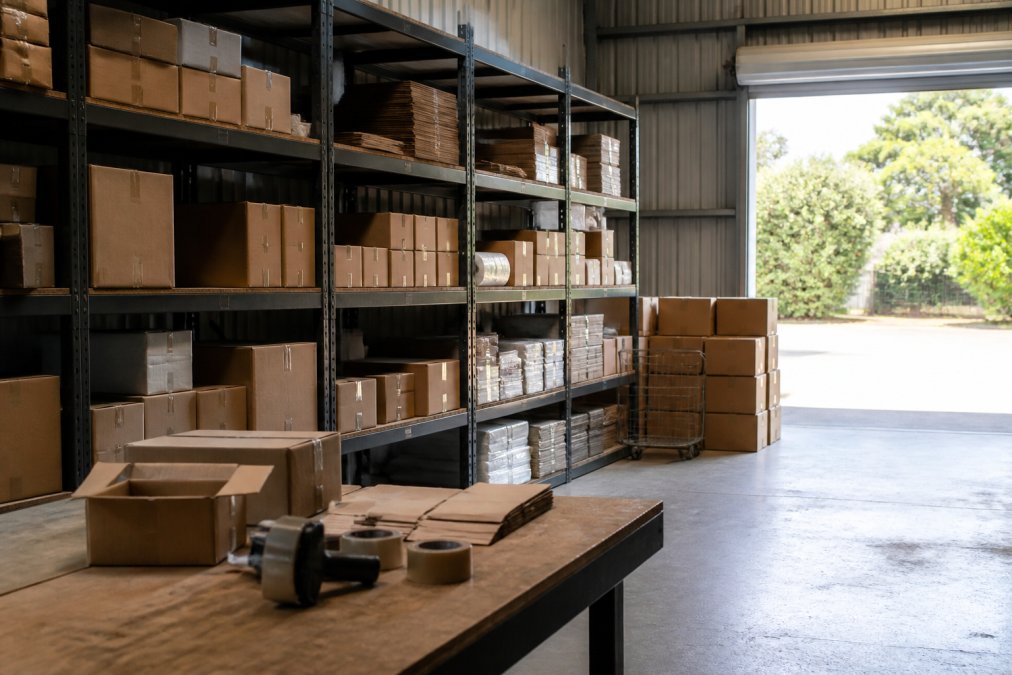
Your layout should follow this pattern:
- Zone 1 (Front/Access): Packing supplies, scales, labels, tape, packaging materials. This is where you assemble orders. Keep it clear and uncluttered so you can move freely.
- Zone 2 (Mid-Unit): Fast-moving inventory. Products that turn over quickly should be at arm height on accessible shelving. This is your 80/20 zone, the 20% of products that generate 80% of your orders.
- Zone 3 (Back/Top Shelves): Slower-moving inventory and overflow stock. These items are accessed less frequently, so they can be higher or deeper in the unit.
Shelving systems are essential. Industrial racking or heavy-duty shelving units let you stack inventory vertically, maximising your usable space. A typical storage unit can hold far more inventory once you’ve installed proper shelving. The investment in racking pays for itself in the first few months through the extra capacity it creates.
Label everything. Use consistent labeling on shelves, bins, and boxes. Include SKU numbers, product names, and quantities. This labeling system should match your inventory management system, ideally, someone unfamiliar with your business should be able to locate any product in under two minutes. modular storage solutions.
Create a simple map of your unit layout and keep it accessible. When you need to hire temporary help during peak season, they can reference your map and find products without asking questions.
Climate Control and Inventory Protection
Climate control matters more than many e-commerce retailers initially realise. Inventory protection depends on the type of products you’re storing.
Products sensitive to temperature and humidity, electronics, cosmetics, textiles, leather goods, need climate-controlled storage (peer-reviewed research). Extreme heat or cold can damage components, degrade materials, or make products unsellable. If you’re storing items that deteriorate in uncontrolled environments, climate control is non-negotiable.
Less sensitive products, books, plastic goods, metal items, can tolerate standard storage. But even these benefit from protection against extreme temperature swings and high humidity, which can cause rust, warping, or mold growth.
The cost of climate-controlled storage is higher than standard units, but it’s insurance against inventory loss. A single batch of damaged products can cost more than several months of climate control premiums.
Moisture control is the other critical factor. Use moisture absorbers or dehumidifiers in your unit, especially in humid climates or during wet seasons. Condensation inside a storage unit can damage cardboard boxes, create mold, and ruin product labels (the EPA). Simple moisture management prevents these problems.
Stack boxes strategically. Don’t place heavy items directly on the floor where moisture can accumulate underneath. Use pallets or shelving to create air circulation beneath your inventory. This prevents water damage and allows air to flow around your stock.
Scaling from Home Storage to Commercial Self Storage
The transition from home-based storage to commercial self storage marks a shift in how you operate your business. Scaling from home storage to commercial self storage should happen when home storage no longer serves your operational needs, not when you run out of space, but when space constraints start slowing you down.

The decision to move typically comes when one of these conditions emerges: your home storage is affecting your living situation, fulfillment times are slowing because inventory is scattered, or you’re losing track of stock because it’s spread across multiple locations.
Before you move, audit your inventory. Identify what you’re actually storing and what’s just taking up space. This is the ideal time to clear out slow-moving items, discontinued products, or damaged goods. You’ll move less inventory, which means you’ll need a smaller (and cheaper) storage unit.
Choose a facility strategically. Location matters less for inventory storage than it does for retail, but proximity to your packing station or home office is still useful. Urban Self Storage locations in Bunbury and Picton offer convenient access, which means you can restock quickly and check on inventory without significant travel time.
Timing is another factor. If you move during a slow sales period, you’ll have more time to organise your new space without the pressure of fulfilling orders simultaneously. Avoid moving during peak season unless it’s absolutely necessary.
The move itself requires planning. Create a detailed inventory list before you move anything. Photograph your current setup so you have a reference if questions arise. Label every box with its contents and destination shelf. This documentation takes time upfront but saves hours during the move and prevents lost items.
Set up your pick-and-pack zone immediately after moving. Don’t wait until you’re settled to create your packing area. You need to start fulfilling orders from the new location as quickly as possible, which means your staging area needs to be functional on day one.
Security and Insurance Considerations for Business Stock
Security and insurance are often overlooked until something goes wrong. For business inventory, they’re essential.
Self storage facilities provide physical security through CCTV surveillance, controlled access, and locked units. Urban Self Storage offers 24/7 CCTV surveillance, which deters theft and provides documentation if an incident occurs. Controlled access means only you (and anyone you authorise) can enter your unit. This protects your inventory from theft and unauthorised access.
However, facility security doesn’t absolve you of personal responsibility. Use a quality padlock. Don’t share your access code with people you don’t fully trust. Keep your inventory list confidential, don’t leave it lying around where someone could see what you’re storing.
Insurance is the critical piece many e-commerce retailers miss. Your homeowner’s or renter’s insurance does not cover business inventory in a storage unit. You need separate coverage. Standard self storage insurance through the facility covers the building and structure, but not the contents of your unit. You need contents insurance that specifically covers business stock.
Talk to your insurance provider about business inventory coverage. Describe what you’re storing, its total value, and the storage duration. They’ll quote a premium that’s typically quite reasonable, often a fraction of what you’d pay for commercial warehouse insurance because self storage is lower-risk than traditional commercial space.
Document your inventory for insurance purposes. Keep detailed records of what you’re storing, including product descriptions, quantities, and values. Photograph high-value items. This documentation is essential if you ever need to file a claim.
The cost of proper insurance is minimal compared to the risk of losing your entire inventory to theft or damage without coverage. It’s a non-negotiable business expense.
Frequently Asked Questions
Q: Is self storage a cost-effective alternative to traditional warehousing for e-commerce?
A: Yes. Self storage eliminates long-term warehouse leases, staffing costs, and fixed overhead. E-commerce retailers pay only for the unit size they need, with flexible month-to-month options. This makes it ideal for seasonal demand fluctuations and growing businesses that cannot justify full warehouse commitment yet. Pricing depends on unit size, location, and lease length, check your provider's website for current rates.
Q: How do you organise inventory in a self storage unit for easy picking?
A: Divide your unit into zones by product category or sales channel. Use shelving systems and clear labelling to speed up order picking. Keep high-turnover items at the front and eye level. Maintain an inventory tracking spreadsheet or software linked to your sales channels so you know exactly where each SKU is stored. This workflow mirrors professional pick-and-pack operations and reduces fulfillment time.
Q: What security features should e-commerce businesses look for in storage?
A: Prioritise 24/7 CCTV surveillance with active monitoring, individual unit locks, and controlled access hours. Ask about insurance options for commercial goods, standard renters' policies often exclude business inventory. Check that access is genuinely available when you need it for order processing and stock rotation.
Q: How can self storage help small e-commerce businesses grow?
A: Self storage provides scalability without capital investment. As your sales grow, you can upgrade to a larger unit or add a second unit without long-term commitment. This flexibility lets you test new product lines, manage seasonal peaks, and separate inventory by supplier or channel. You avoid warehouse setup costs and can redirect savings into marketing, product development, or fulfillment speed improvements.
Scaling your e-commerce business requires reliable inventory management. When home storage no longer works, self storage provides the flexibility and security you need to grow without overcommitting to expensive long-term warehouse leases. Urban Self Storage offers secure, flexible storage solutions with 24/7 CCTV surveillance and convenient access across Western Australia. Book online now and get your inventory organised for faster fulfillment and better order management.
This article was written using GrandRanker