
Table of Contents
- What You’ll Need Before Booking a Book Storage Unit Online
- Storage Unit Size Guide for Books
- How to Pack Books for Long-Term Storage
- Climate-Controlled Storage Units for Book Preservation
- Booking Your Book Storage Unit Online: Step-by-Step
- Security, Insurance, and Inventory Management
- Common Mistakes to Avoid When Storing Books
- Conclusion
Last Updated: August 12, 2026
What You’ll Need Before Booking a Book Storage Unit Online
Before booking a book storage unit online, gather sturdy moving boxes, acid-free tissue paper, reinforced packing tape, and labels. For valuable editions, add moisture-absorbing packets and create a spreadsheet inventory listing each box number and contents before packing begins. Photograph your collection for insurance purposes if it’s worth more than a few hundred dollars.
Urban Self Storage locations offer climate-controlled units suited for book preservation, but your preparation determines how well your collection survives storage. Check whether dust jackets need separate protection, wrap hardcovers individually, and group paperbacks efficiently. Temperature fluctuations and humidity damage books slowly, you won’t see harm until months pass, making facility choice as important as preparation.
Storage Unit Size Guide for Books
The right unit size depends on your collection’s volume and access needs. A small library of 200-300 books fits in a 2.5 x 2 metre unit; 500-800 books need 3 x 3 metres; collections exceeding 1,000 volumes need at least 3 x 4 metres.
A standard moving box holds roughly 15-20 books. A 500-book collection requires 25-35 boxes. Stacked three high, that’s 8-12 square metres of floor space just for books. Add space for walking and climate equipment, making a 3 x 3 metre unit realistic for medium collections.
If you’ll retrieve books frequently, choose a unit large enough for a centre aisle. For long-term archive storage, stacking density matters less than climate stability. Business inventory with 2,000-5,000 units needs a 4 x 6 metre unit with shelving systems for efficient retrieval.
How to Pack Books for Long-Term Storage
Sort books by size, large volumes on bottom, smaller on top. Wrap each book individually in acid-free tissue paper, protecting dust jackets carefully. Avoid newspaper, which transfers ink to pages over time.
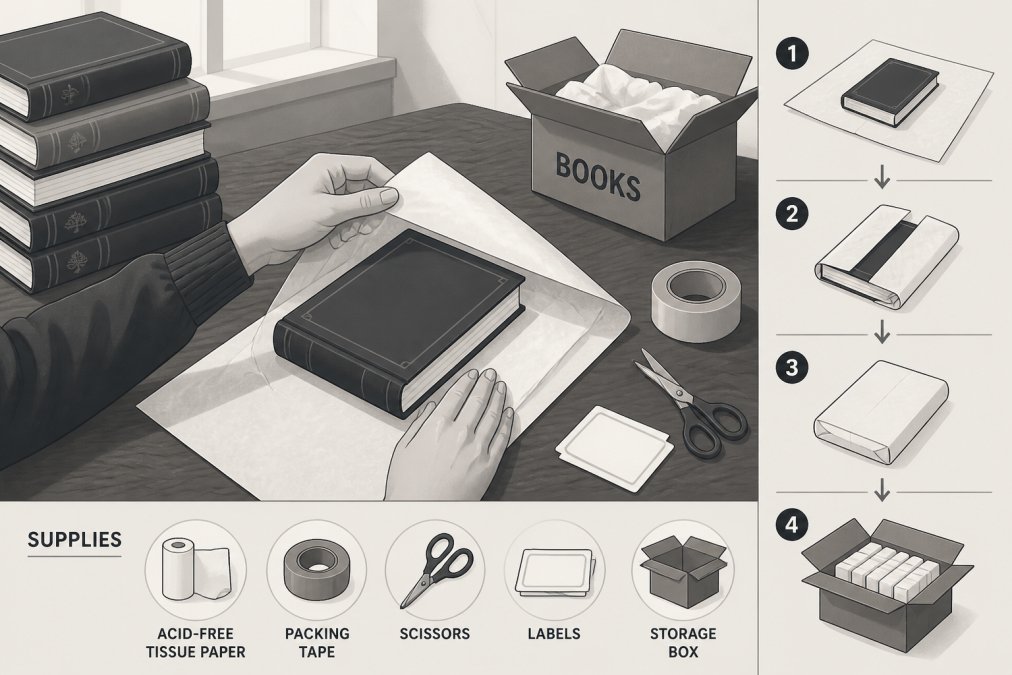
Fill boxes to 15-20 kilograms, heavy enough to stay compact but light enough to lift safely. Place heavier books on bottom layers. Use acid-free packing paper between layers to prevent pages sticking in humid conditions. Seal all boxes with reinforced tape on bottom, top, and seams.
Label each box clearly with contents and collection section. Number boxes sequentially and note contents on your inventory spreadsheet. Store boxes upright rather than flat to distribute weight evenly and reduce spine pressure. Never stack lighter boxes under heavier ones.
For valuable or antique books, use individual archival-grade storage boxes instead of standard moving boxes. These acid-free containers with reinforced corners protect rare editions from physical and chemical damage.
Climate-Controlled Storage Units for Book Preservation
Temperature stability and humidity control separate adequate storage from preservation-grade storage. Books deteriorate when temperature swings cause paper fibres to expand and contract repeatedly. Humidity above 65% encourages mould; below 30% causes brittle pages. Climate-controlled units maintain 45-55% humidity and 18-21 degrees Celsius year-round.
Paper is hygroscopic, it absorbs and releases moisture based on surrounding air. In uncontrolled storage, pages absorb moisture during humid periods and release it during dry periods, warping covers and rippling pages. Mould spores germinate at 60% humidity and spread rapidly through collections. Climate control prevents this damage cascade.
Urban Self Storage‘s climate-controlled units use dehumidification and temperature regulation to maintain optimal conditions. This matters most for valuable collections, business inventory, and archival material. If storing 1,000+ books or editions worth significant money, climate control is insurance against loss.
Dust accumulation damages long-term. Dust particles embed in pages and bindings; wiping them away can scratch covers and abrade edges. Climate-controlled facilities maintain air filtration systems that reduce dust circulation compared to standard units.
Booking Your Book Storage Unit Online: Step-by-Step
The online booking process takes minutes once you know your unit size and storage duration. Visit Urban Self Storage’s website and use their size calculator or contact form to specify your needs. Describe your collection, number of boxes, climate control requirements, and access frequency.

Review available unit sizes and rental terms. Urban Self Storage offers flexible short-term options for renovations or relocations, and long-term agreements for permanent archive storage. Select your preferred unit size and move-in date. The system shows available units in real-time.
Provide contact information and storage requirements, including whether your collection contains valuable editions or needs frequent access. Specify your preferred move-in time. Review the rental agreement carefully, checking monthly rates, promotional discounts, cancellation terms, and access hours. Urban Self Storage’s transparent pricing shows all costs upfront.
Once booked, you’ll receive access details and instructions. Many facilities provide 24/7 access codes or key cards. Clarify access procedures with the facility team and ask about CCTV surveillance coverage and how it operates.
Security, Insurance, and Inventory Management
Your stored books need protection from theft, damage, and loss. Urban Self Storage facilities feature 24/7 CCTV surveillance monitoring all common areas and unit entrances. Ask about surveillance coverage, camera positioning, real-time monitoring, and recording retention periods.
Access control matters as much as surveillance. Modern facilities use key cards or digital codes creating audit trails showing who accessed which units and when. Ensure your unit has a quality padlock; many facilities require approved locks.
Insurance coverage protects your collection if damage occurs. Check whether your home or business insurance extends to off-site storage, most policies exclude items in commercial facilities or limit coverage to a few hundred dollars. If your collection is valuable, purchase additional coverage through the facility or a specialized provider. Document your inventory with photographs before moving in.
Create a detailed spreadsheet listing each box number, contents, and approximate book values. Update this whenever you retrieve or add boxes. For business users, digital inventory systems let you search for specific titles without opening every box.
For valuable or archival collections, consider archival-grade preservation beyond standard climate control. Acid-free boxes, tissue paper, and moisture-absorbing packets create museum-quality conditions. These materials preserve rare editions indefinitely.
Common Mistakes to Avoid When Storing Books
The biggest mistake is choosing standard storage to save money. Climate-controlled units cost only 20-30% more monthly, far less than damage repair or replacement. Valuable collections make this obvious, but even casual libraries benefit from climate stability.
Packing books in unsuitable containers wastes space and risks damage. Plastic bins trap moisture; undersized boxes crush pages and spines; newspaper contains acids that degrade pages. These mistakes seem minor until you open boxes months later and discover warped covers or mould.
Inadequate labelling creates frustration when retrieving specific books. Unlabelled boxes force searching through dozens of containers. Vague labels like "Fiction" don’t help locating one title among hundreds. Invest time in clear, detailed labelling.
Storing books in damp basements or uninsulated attics before moving them damages them immediately. Move books to climate-controlled facilities as soon as possible. Damage beginning in unsuitable locations accelerates in storage if conditions don’t improve.
Neglecting inventory updates means losing track of stored items. If you add boxes later or retrieve some, update your spreadsheet. Current inventory prevents duplicate purchases and helps locate specific titles. For business inventory, accurate records are essential for tax purposes and stock rotation.
Ignoring access needs when choosing unit size creates problems later. If you need frequent retrieval, a tiny unit with ceiling-high stacked boxes becomes impractical. Choose a unit slightly larger than minimum needs to allow comfortable access.
Underestimating your collection’s volume is remarkably common. Use the storage unit size guide provided, then add 20% extra. It’s better to have unused space than overflow your unit and pay overage fees.
Storing books properly protects your investment and preserves your collection for years. The process begins before booking a book storage unit online, with proper packing, appropriate sizing, and climate control selection. Urban Self Storage’s facilities offer secure, climate-controlled environments that books require, with flexible rental terms and straightforward online booking. Their 24/7 CCTV surveillance and quick move-in process eliminate common storage concerns. Whether relocating, renovating, or managing business inventory, choosing a facility that prioritizes climate stability and security ensures your collection emerges in the same condition you stored it. Book your storage unit online today and give your collection the protection it deserves.
Frequently Asked Questions
What is the best way to store books in a storage unit?
Store books upright on shelves rather than stacked flat, as this prevents spine damage and allows air circulation. Use acid-free boxes, packing paper, and moisture-absorbing materials. Keep books away from direct light and maintain consistent temperature and humidity levels. Climate-controlled storage units protect against temperature fluctuations and humidity that cause mould, warping, and paper deterioration. Add desiccants or dehumidifiers to absorb excess moisture, and check on your collection periodically.
How do I know what size storage unit I need for my book collection?
A small unit (3m²) holds approximately 500-800 books, a medium unit (6m²) holds 1,200-1,800 books, and a large unit (10m² or more) accommodates 2,500+ books with room for shelving. Count your books and measure their average thickness to estimate volume. Factor in shelving or bookcases you plan to store alongside them. If storing other items too, add that space to your calculation. Use an online storage unit size guide or contact the facility for a personalised quote.
Should books be stored flat or upright in a storage unit?
Books should be stored upright, not flat. Stacking books flat puts pressure on the spine and binding, causing permanent damage over time. Standing them upright on shelves or in boxes allows the spine to rest naturally and lets air circulate around each book. If space is tight, store them in small, manageable stacks no higher than 30 centimetres, with heavier books at the bottom.
What climate control features should I look for when booking storage for valuable books?
Choose a climate-controlled unit that maintains stable temperature (ideally 15-21°C) and humidity levels (between 30-50% relative humidity). Fluctuating conditions cause paper expansion, contraction, mould growth, and foxing. Look for units with dehumidification systems, proper insulation, and ventilation. Archival-quality storage combines climate control with acid-free materials and protection from pests and light. Check the facility's monitoring systems to ensure conditions are actively maintained, not just passively climate-controlled.
This article was written using GrandRanker