
Table of Contents
- Why Overnight Tool Storage Matters for Tradies
- How to Prevent Tool Theft from Work Vehicles
- Benefits of Off-Site Equipment Storage
- Short-Term Tool Storage for Contractors
- Choosing the Right Unit Size and Security Features
- 24/7 Access and Workflow Optimisation
- Tax Deductibility and Cost-Saving Strategies
- Getting Started with Overnight Tool Storage
Why Overnight Tool Storage Matters for Tradies
Tool theft from work vehicles costs tradies thousands each year (abs.gov.au). A single theft can wipe out weeks of profit, delay projects, and force expensive replacements mid-contract. Overnight tool storage solves this by moving your most valuable assets into a secure facility with 24/7 CCTV surveillance, gated access, and professional-grade security.
For contractors managing multiple job sites or working in high-theft areas, off-site commercial storage delivers the security and accessibility that on-vehicle solutions can’t match. This guide covers why theft happens, how to prevent it, what off-site storage delivers, and how to choose the right unit for your operation, including tax deductibility and cost-saving strategies most tradies overlook.
How to Prevent Tool Theft from Work Vehicles
Tool theft from work vehicles happens in patterns. Thieves target parked utes at job sites, overnight in residential areas, or during lunch breaks. Prevention starts with visibility and deterrence: lock your ute, use a steering wheel lock, and park in well-lit areas. But these measures only reduce risk.
The most effective approach combines vehicle-level and facility-level protection:
- Vehicle-level: Secure toolboxes mounted on your ute tray, lockable aluminium canopies, or heavy-duty site boxes with multi-point locking mechanisms like the AF® HD Site Box with welded steel construction and 3-point locking.
- Facility-level: Moving tools to a dedicated storage unit with perimeter fencing, access control, and 24/7 CCTV surveillance.
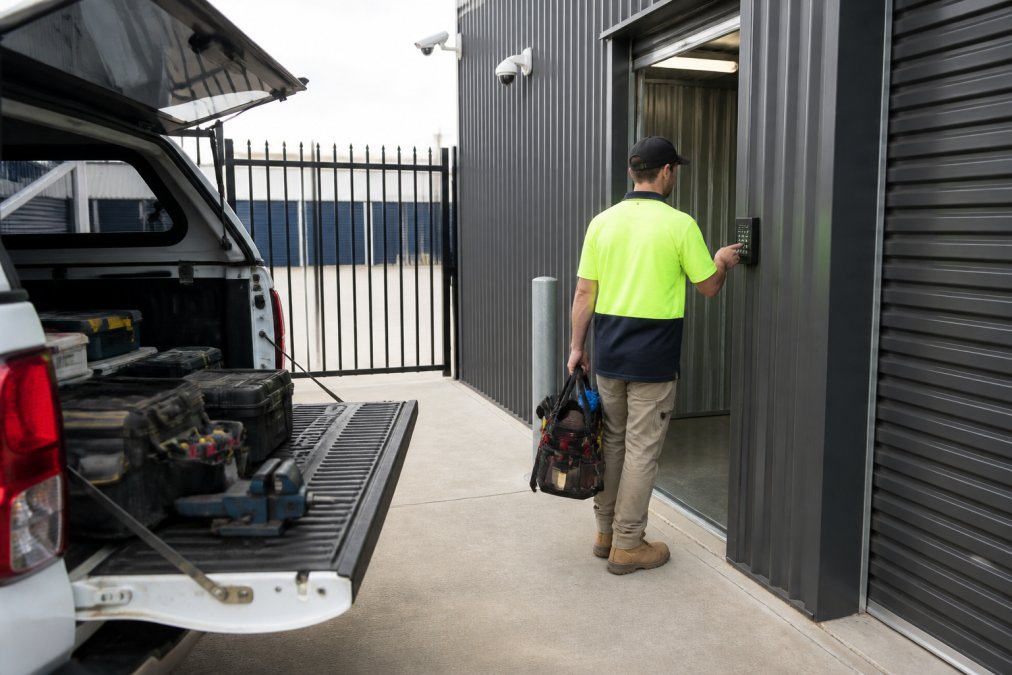
Facility-based storage transfers security responsibility to professionals. Urban Self Storage uses advanced 24/7 CCTV surveillance and gated access with unique PIN codes at both its East Bunbury and Picton locations. For tradies working across multiple sites, this approach saves time, you don’t need to lock and unlock every tool individually or worry about forgetting something.
Benefits of Off-Site Equipment Storage
Off-site storage delivers three core benefits that on-vehicle solutions can’t match: security, organisation, and workflow efficiency.
Security is paramount. A dedicated facility with perimeter fencing, access control, and 24/7 CCTV provides asset protection a locked ute can’t. Tools are stored in a climate-controlled, moisture-proof environment, protected from weather, theft, and damage.
Organisation forces you to inventory what you have and create a system: power tools in one section, hand tools in another, materials in a third. This saves time on every job because you know exactly what’s where.
Workflow efficiency matters most. Instead of returning to a home base to grab tools, you access your storage unit on the way to the first job. With 24/7 access and drive-up convenience at Urban Self Storage, you’re in and out in minutes. For contractors managing teams, off-site storage also simplifies handover, crew members use their own PIN codes without coordinating key exchanges.
Short-Term Tool Storage for Contractors
Most facilities offer flexible short-term rental options with no lock-in contracts. This works for renovation projects (3-6 months), seasonal work, equipment rotation, or job site overflow. Short-term storage removes financial pressure, you pay only for the weeks or months you actually need the space. Many facilities offer first-month discounts; Urban Self Storage provides discounts on initial rentals, which can offset setup costs entirely.
Choose a facility with flexible terms that don’t penalise early exit. Your business moves fast; your storage arrangement should too.
Choosing the Right Unit Size and Security Features
Unit size is the most common mistake. Tradies either overestimate and pay for unused space, or underestimate and rent two units. Measure your inventory first.
| Item Category | Space Required | Notes |
|---|---|---|
| Power tools (drill, circular saw, impact driver) | 1-2 cubic metres | Wall-mounted storage saves floor space |
| Hand tools (hammers, wrenches, screwdrivers) | 0.5-1 cubic metre | Toolboxes stack efficiently |
| Heavy machinery (compressor, generator) | 2-3 cubic metres | Requires floor space; check weight limits |
| Materials (timber, plasterboard, pipes) | 3-5 cubic metres | Varies by trade; adjust accordingly |
| Vehicles (trailer, ride-on mower) | 6-10 cubic metres | Requires drive-up access and height clearance |
Urban Self Storage offers multiple unit sizes, from small lockers to extra-large units up to 5.9 metres by 4.8 metres. Start by listing what you store, estimate the volume, then add 20% for reorganisation and future purchases.
Verify these security non-negotiables:
- 24/7 CCTV surveillance: Cameras should cover all access points. Ask if footage is monitored in real-time or recorded only.
- Access control: Unique PIN codes per user let you track who accessed the facility and when.
- Perimeter security: Gated access with secure fencing prevents casual theft.
- Climate control: Prevents rust and corrosion on moisture-sensitive tools.
- Insurance compatibility: Check whether your business insurance covers stored equipment at off-site facilities.
Urban Self Storage’s facilities meet these standards across both East Bunbury and Picton locations, with gated access, 24/7 CCTV, and flexible unit sizes designed for contractors and tradies.
24/7 Access and Workflow Optimisation
Access flexibility is critical. If you can only access your unit during business hours, the system breaks down. True 24/7 access means you control when you come and go, no staff hours to work around, no gates locked at 5 PM, no weekend closures.
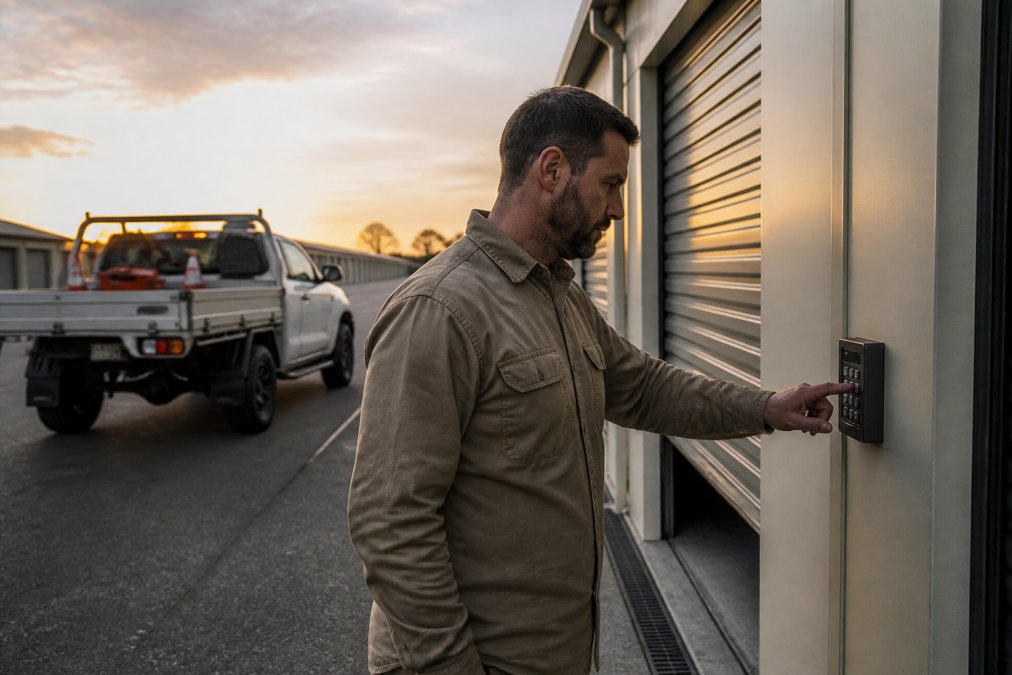
A typical tradie’s day might include early morning access before the first job, midday tool swaps between sites, and evening unloads. This workflow only works with 24/7 access. Drive-up access amplifies this benefit, you drive directly to your unit and load from your ute without carrying tools across a parking area, saving 10-15 minutes per visit. construction site security.
Urban Self Storage’s Bunbury locations offer both 24/7 access and drive-up convenience, with units sized to accommodate utes and trailers.
Tax Deductibility and Cost-Saving Strategies
Storage costs for business equipment are often tax-deductible (ato.gov.au). Under Australian Taxation Office guidelines, storage for tools, machinery, materials, and inventory used in your trade qualifies as a business expense (ato.gov.au). This includes monthly rental fees, insurance on stored equipment, access fees, and climate control upgrades.
Track these expenses:
- Keep all rental invoices and payment receipts
- Document what’s stored and its business purpose
- If you share a unit with personal items, allocate the cost proportionally
- Track any insurance or additional fees separately
Cost-saving strategies:
-
Negotiate longer-term discounts: Monthly rates are higher than quarterly or annual rates. Ask for a discount if you’ll need storage for 6+ months.
-
Right-size your unit: Measure first. Adjust later if needed.
-
Share a unit: Splitting a large unit with other tradies reduces everyone’s cost.
-
Use short-term rental strategically: Don’t rent year-round if you only need storage seasonally.
-
Bundle services: Ask what package discounts are available.
Storage pricing depends on quantity, dates, and delivery. Factor in theft prevention, equipment protection, and workflow efficiency, and the ROI is clear.
Getting Started with Overnight Tool Storage
Setting up overnight tool storage takes less time than most tradies expect.
Step 1: Assess your needs (15 minutes)
List what you’re storing. Measure the volume. Add 20% buffer. Check whether you need drive-up access, climate control, or specific security features.
Step 2: Choose a facility (30 minutes)
Visit the facility or review photos online. Verify 24/7 access, CCTV coverage, and unit sizes. Ask about first-month discounts and confirm no lock-in contracts. Urban Self Storage’s East Bunbury and Picton locations offer flexible terms with no long-term commitments required.
Step 3: Complete the rental agreement (10 minutes)
Urban Self Storage’s move-in process takes less than 10 minutes. Provide ID, confirm insurance details, and receive your PIN code. No paperwork delays or hidden fees.
Step 4: Load and organise (1-2 hours)
Wall-mount shelving for small tools. Stack heavy items safely. Label everything. Create a simple inventory list. This upfront effort saves hours later when searching for specific tools.
Step 5: Establish your routine (ongoing)
Develop a daily rhythm: end-of-day unload and organise, start-of-day load what you need. Within a week, it becomes automatic. You’ll notice workflow efficiency immediately.
=== FAQ ANSWERS (audit these too, same rules) ===
[1] Q: Can I access my overnight tool storage at any time, even outside business hours? A: Yes. Secure storage facilities offer 24/7 access with unique PIN codes and electronic gate systems, so you can retrieve tools before early starts or after finishing work. This flexibility is essential for tradies managing multiple job sites or unpredictable schedules. Access control means only you can enter, and CCTV surveillance monitors activity round the clock, giving you both convenience and security.
[2] Q: What security features should I look for in overnight tool storage? A: Prioritise facilities with 24/7 CCTV surveillance, perimeter fencing, individual unit locks, electronic gate access with PIN codes, and gated entry points. Anti-theft measures like motion-sensor lighting and secure loading bays add extra protection. Check that the facility is regularly inspected and that security systems are actively monitored, not just recorded. Ask for evidence of how the facility responds to incidents.
[3] Q: Is overnight tool storage tax-deductible for my contracting business? A: Storage costs for business equipment and tools are generally tax-deductible as a business expense under the Australian Tax Office guidelines. Keep receipts and invoices showing the storage is used exclusively for work equipment. If you use the storage partly for personal items, only the business portion is deductible. Consult your accountant to confirm eligibility based on your specific business structure and use.
[4] Q: How do I know what size unit I need for my tools and equipment? A: List your largest items (power tools, machinery, materials) and measure them. Most facilities offer multiple sizes, from compact lockers for hand tools to extra-large units (up to 5.9m × 4.8m) for heavy-duty machinery and vehicles. Start by visiting the facility to see units in person, this prevents guessing and wasting money on space you don’t need. Staff can advise on the best fit based on your inventory.
Frequently Asked Questions
Q: Can I access my overnight tool storage at any time, even outside business hours?
A: Yes. Secure storage facilities offer 24/7 access with unique PIN codes and electronic gate systems, so you can retrieve tools before early starts or after finishing work. This flexibility is essential for tradies managing multiple job sites or unpredictable schedules. Access control means only you can enter, and CCTV surveillance monitors activity round the clock, giving you both convenience and security.
Q: What security features should I look for in overnight tool storage?
A: Prioritise facilities with 24/7 CCTV surveillance, perimeter fencing, individual unit locks, electronic gate access with PIN codes, and gated entry points. Anti-theft measures like motion-sensor lighting and secure loading bays add extra protection. Check that the facility is regularly inspected and that security systems are actively monitored, not just recorded. Ask for evidence of how the facility responds to incidents.
Q: Is overnight tool storage tax-deductible for my contracting business?
A: Storage costs for business equipment and tools are generally tax-deductible as a business expense under the Australian Tax Office guidelines. Keep receipts and invoices showing the storage is used exclusively for work equipment. If you use the storage partly for personal items, only the business portion is deductible. Consult your accountant to confirm eligibility based on your specific business structure and use.
Q: How do I know what size unit I need for my tools and equipment?
A: List your largest items (power tools, machinery, materials) and measure them. Most facilities offer multiple sizes, from compact lockers for hand tools to extra-large units (up to 5.9m × 4.8m) for heavy-duty machinery and vehicles. Start by visiting the facility to see units in person, this prevents guessing and wasting money on space you don't need. Staff can advise on the best fit based on your inventory.
Getting tools secured overnight shouldn’t be complicated. Urban Self Storage removes the friction. Flexible short-term rentals, 24/7 access, and competitive pricing mean you can start protecting your equipment this week. Book online now and get your first month at a discount. Your tools, and your peace of mind, are worth it.
This article was written using GrandRanker